The most comprehensive analysis of ransomware threats in 2026, covering Qilin, LockBit 5.0, Akira, CL0P, and all major threat actors. Complete with victim statistics, attack trends, law enforcement effectiveness, and actionable defense strategies. 12,000+ projected victims. 58% YoY increase. This is the ransomware landscape report every CISO needs to read.
Executive Summary
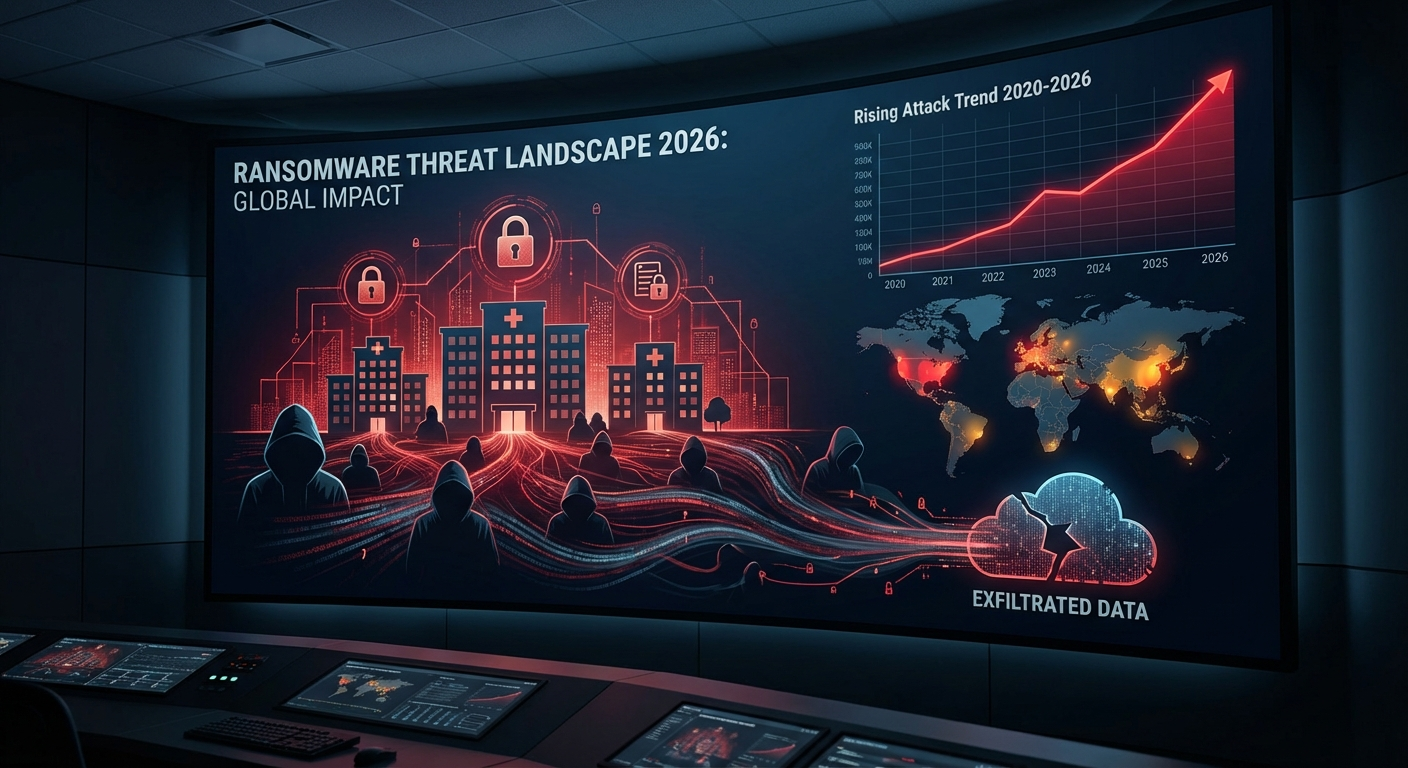
Ransomware in 2026 is no longer an emerging threat—it is a mature, industrialized criminal economy operating at unprecedented scale. Despite a year of aggressive law enforcement operations, including Operation Cronos’s dismantling of LockBit infrastructure, the seizure of the RAMP forum, and arrests spanning four continents, ransomware attacks increased 58% year-over-year. Groups averaged nearly 700 victims per month across the final four months of 2025, with no signs of deceleration entering the new year.
This report represents the most comprehensive analysis of the 2026 ransomware landscape available. We profile every major threat group, examine the tactics driving modern attacks, assess law enforcement effectiveness, and provide actionable intelligence for defenders navigating what has become the single greatest operational threat facing organizations worldwide.
The findings are sobering: despite unprecedented law enforcement action, despite billions in defensive spending, despite growing awareness—the criminals are winning. And the gap is widening.
The Numbers That Matter
MetricValueContextYoY Attack Increase58%Highest growth rate since 2019Q4 2025 Victims2,018Single quarter recordJanuary 2026 Victims679On pace for 8,000+ annuallyHealthcare Attacks (Jan 2026)27Most targeted sectorActive Groups126-141Up from 72 in 2023Attacks with Data Exfiltration74%Data theft now standardUnclaimed Attacks49%True scale vastly understated2026 Projected Victims12,000+If trajectory holds
The most troubling statistic: nearly half of all ransomware attacks go unclaimed by known groups. The visible landscape—the leak sites, the negotiations, the headlines—represents only the tip of a much larger criminal iceberg.
Part I: The Industrial Phase of Ransomware
Understanding the 58% Surge
The ransomware ecosystem has entered what we are terming its “industrial phase”—a period characterized by commoditized attack infrastructure, professional affiliate networks, and operational processes that would be familiar to any Fortune 500 executive. This isn’t cybercrime anymore. It’s cyberbusiness.
The 58% year-over-year increase in attacks defies the conventional narrative that law enforcement actions are turning the tide. While tactical victories continue—arrests, infrastructure seizures, decryptor releases—the strategic picture remains grim. Ransomware attacks are increasing faster than defenses can adapt.
Several factors drive this acceleration:
1. The Fragmentation Effect
When law enforcement disrupts a major operation, the result is rarely elimination—it’s fragmentation. LockBit affiliates didn’t retire after Operation Cronos; they dispersed across competing platforms. The affiliate pool expanded rather than contracted, and groups like Qilin and Akira absorbed experienced operators hungry for new homes.
2. The RaaS Economy Matures
Ransomware-as-a-Service has become genuinely commoditized. The barrier to entry has never been lower. Modern RaaS platforms provide:
- Turnkey encryption/decryption infrastructure
- Automated negotiation portals
- Professional victim communication systems
- Technical support for affiliates
- Revenue sharing models that minimize upfront costs
An aspiring cybercriminal can become operational within hours. LockBit 5.0’s decision to drop affiliate fees to just $500—down from thousands—reflects this competitive, low-barrier market.
3. Data-Only Extortion Rises
The shift from encryption to pure data extortion is accelerating. In 2026, 74% of ransomware attacks involve data exfiltration, with a growing number skipping encryption entirely. This evolution has profound implications:
- Speed: Data theft takes minutes; encryption takes hours
- Stealth: No encryption behavior means fewer EDR triggers
- Backup irrelevance: Perfect backups don’t help when data is already stolen
- Regulatory leverage: GDPR, HIPAA, and emerging privacy laws add legal pressure
For attackers, data-only extortion is simply more efficient. Expect this trend to accelerate.
Geographic Distribution: The American Concentration
The United States absorbs a disproportionate share of global ransomware activity:
CountryShare of Global AttacksUnited States46-58%Australia10-14%United Kingdom8-10%Germany5-7%Canada4-5%France3-4%
This concentration reflects several realities: the size of the American economy, the prevalence of cyber insurance (which can signal payment capacity), weaker data protection regulations creating incentive misalignment, and—bluntly—the fact that most ransomware operators reside in nations adversarial to the United States.
CL0P’s recent campaign temporarily elevated UK and Australian percentages, demonstrating how a single group’s focus can shift geographic patterns. But the fundamental American concentration remains structural.
Sector Targeting: Healthcare in Crisis
Healthcare has emerged as the sector facing the greatest ransomware pressure:
SectorAttack Share (Q2 2025)Professional Services19.7%Healthcare13.7%Consumer Services13.7%Manufacturing10-12%Government/Public Sector9.4%Financial Services7.7%IT Services6-8%Education5-6%
January 2026 saw 27 healthcare ransomware incidents—more than any other sector. The reasons are grimly logical:
Why Attackers Target Healthcare:
- Operational Pressure: Patient care cannot wait. Every hour of downtime directly threatens lives, creating payment urgency that other sectors lack.
- Data Value: Medical records contain comprehensive personal information—SSNs, insurance details, diagnoses, treatment histories—commanding premium dark web prices.
- Regulatory Leverage: HIPAA violations, breach notification requirements, and potential lawsuits add legal and financial pressure beyond the ransom itself.
- Legacy Infrastructure: Many healthcare systems run aging, unpatched technology. Connected medical devices expand attack surfaces.
- Underfunded IT: Healthcare IT security budgets consistently lag behind threat sophistication.
The human cost is staggering. Research indicates ransomware-affected hospitals see increased patient mortality, longer emergency department wait times, delayed procedures, and ambulance diversions. The average hospital loses access to electronic health records for 18 days following an attack.
When ransomware hits a hospital, patients don’t just lose data—they lose time. In emergency medicine, time is measured in lives.
In 2025, 445 ransomware attacks struck hospitals, clinics, and direct care providers—a 49% year-over-year increase. The crisis is intensifying, not abating.
Part II: Threat Actor Profiles
Tier 1: The Dominant Powers
These groups represent the apex of the ransomware ecosystem—well-resourced, operationally sophisticated, and responsible for the largest share of global attacks.
Qilin: The New King
2025 Victims: ~1,000+ January 2026 Victims: 115 Primary Targets: Healthcare, Manufacturing Technical Stack: Rust-based ransomware
Qilin has claimed the top position in the ransomware hierarchy since April 2025 and shows no signs of relinquishing it. The group’s operational tempo is relentless: over 100 victims monthly has become routine. In ransomware terms, this is market dominance—and they know it.
The Synnovis pathology lab attack in the UK demonstrated Qilin’s willingness to target critical healthcare infrastructure. The attack caused over $40 million in direct losses, disrupted blood transfusion services across London hospitals, and forced the postponement of thousands of medical procedures. The ripple effects lasted months.
Recent Notable Victims:
- Philippine Savings Bank (Metrobank subsidiary)
- U.S. regional airport authority
- Taiwan semiconductor manufacturer (~275 GB exfiltrated)
- Cressi (Italian scuba equipment manufacturer)
Qilin’s Rust-based ransomware variant complicates analysis and detection. The group actively recruits affiliates and maintains aggressive negotiation tactics. There is no sector they won’t target, no victim too sensitive.
Assessment: Qilin will remain the dominant threat through 2026. Expect continued healthcare targeting.
Akira: The Consistent Threat
2025 Victims: 947 (+125% YoY) Q1 2026 Victims: 76 claimed Primary Targets: SMBs, Manufacturing, MSPs Combined Market Share with RansomHub: 25%
Akira has demonstrated remarkable operational consistency, maintaining top-three status month after month. Where other groups experience volatility—takedowns, rebranding, internal disputes—Akira simply executes.
The group’s focus on small and medium businesses, manufacturing facilities, and managed service providers reflects sophisticated target selection. MSP compromises, in particular, offer multiplicative impact: a single successful breach can yield access to dozens of downstream client networks.
Technical Evolution: Akira migrated to a C++ implementation for improved stability and performance—a sign of organizational maturity. The group’s $244 million+ in estimated illicit revenue makes them one of the highest-earning operations active today.
Assessment: Akira’s consistency is its greatest strength. The group represents a persistent, reliable threat across sectors.
CL0P: The Supply Chain Specialist
2025 Victims: 594 (+525% YoY) Current Status: Actively campaigning Specialty: Enterprise software vulnerability exploitation Primary Targets: IT, Banking, Construction, Healthcare
CL0P’s explosive 2025 growth—a staggering 525% increase in victims—stems from successful supply chain attacks exploiting vulnerabilities in enterprise software. Their campaign against Oracle E-Business Suite vulnerabilities drove supply chain attacks to all-time highs in October 2025.
CL0P doesn’t target individual organizations; they target software. A single vulnerability in widely-deployed enterprise applications yields access to hundreds of victims simultaneously. This is the ransomware equivalent of a weapons of mass disruption—one exploit, infinite targets. This efficiency model has made them extraordinarily dangerous.
Campaign Characteristics:
- Claims victims in clusters (dozens at once)
- Exploits enterprise software zero-days
- Supply chain focus for maximum impact
- Heavy targeting of UK and Australian organizations
The group’s current campaign—claiming victims with no disclosed technical details—suggests they’re sitting on another unpatched vulnerability.
Assessment: CL0P’s supply chain model is the most scalable attack paradigm in ransomware. Any organization running enterprise software should monitor CL0P disclosures closely.
PLAY: The Methodical Operator
2025 Victims: ~355 Primary Targets: Professional Services, Title Companies, MSPs Style: Methodical, deadline-driven
PLAY lacks the flash of larger operations but compensates with methodical execution. The group focuses intensely on U.S. professional services—law firms, title companies, accounting firms—where sensitive client data creates maximum pressure.
Recent Victims (February 2026):
- Heartland Title Services
- UCG Associates
- Unified Engineering
- Lusamerica Foods
- Catalanatto & Barnes
- Esquire Brands (children’s footwear)
- Garner Foods (Texas Pete hot sauce manufacturer)
PLAY’s victim selection reveals strategic thinking: organizations with sensitive client relationships, regulatory obligations, and reputational concerns. They apply deadline pressure systematically, claiming access to payroll records, client financials, and privileged documents.
Assessment: PLAY is the professional services sector’s nightmare—competent, consistent, and focused.
Tier 2: The Rising Powers
These groups have demonstrated rapid capability development and operational scaling. They represent the next generation of ransomware leadership.
Sinobi: The Healthcare Threat
Emergence: July 2025 Q4 2025 Growth: 300%+ Likely Origin: Lynx ransomware offshoot Primary Concern: Healthcare sector targeting
Sinobi represents one of the most alarming emerging threats. Intelligence assessments consistently flag the group as posing significant healthcare risk in 2026—and recent operations support this assessment.
The group’s claimed victims include:
- Halcyon Technologies (~270 GB claimed)
- Halcyontek
- The Sundher Group
- India-based IT services company (150+ GB including Hyper-V servers)
- Venesco
The irony of Sinobi attacking Halcyon Technologies—an anti-ransomware security vendor—wasn’t lost on the threat intelligence community. Stealing 270 GB from a company whose entire business is preventing exactly this outcome demonstrates either remarkable audacity or remarkable capability. Likely both.
Assessment: Sinobi’s trajectory suggests top-tier status within 12 months. Healthcare organizations should prioritize Sinobi-related IOCs.
The Gentlemen: The High-Velocity Newcomer
Total Victims: 128-130+ Operational Tempo: Near-daily victim postings Attribution: Linked to actor “hastalamuerte” Notable Characteristic: Geographic diversity
The Gentlemen has built an unusually wide operational footprint spanning sectors and geographies. Unlike groups that concentrate on specific regions or industries, The Gentlemen attacks opportunistically—anywhere, anyone.
Recent Victims Demonstrate This Breadth:
- City of New Castle (U.S. municipal government)
- Bank of Mauritius (African banking)
- L’Aeroclub (Europe’s largest aviation club)
- Ankara-İzmir High-Speed Railway Project (Turkish infrastructure)
- BAM - Brand Art Media (Netherlands)
- MBM Poland (professional training)
Technical Indicators:
CategoryDetailFile ExtensionRandom 6 characters (e.g., .7mtzhh)Ransom NoteREADME-GENTLEMEN.txtBYOVD DriverThrottleBlood.sys (CVE-2025-7771)EDR KillersAll.exe, Allpatch2.exeExfiltration ToolWinSCPCommunicationTox messenger + Tor
The Gentlemen’s use of Bring Your Own Vulnerable Driver (BYOVD) techniques to achieve kernel-level EDR termination demonstrates technical sophistication. The group uses GPO manipulation for domain-wide deployment and systematically destroys forensic evidence—deleting shadow copies, event logs, and prefetch data.
Assessment: The Gentlemen’s velocity and technical capability merit top-tier classification within 2026.
GENESIS: The Healthcare Hunter
Status: Active Recent Attack: CHASI/Sun River Health (nonprofit healthcare) Characteristic: No qualms about vulnerable targets
GENESIS’s willingness to attack nonprofit healthcare providers—organizations serving vulnerable populations with limited resources—exemplifies the ecosystem’s complete abandonment of ethical constraints that some early operators at least pretended to observe.
The CHASI/Sun River Health attack targeted a federally qualified health center serving low-income communities. The message is clear: there are no protected categories.
Assessment: GENESIS represents the normalization of attacks against the most vulnerable institutions.
Tier 3: The Resilient (LockBit 5.0)
LockBit 5.0: The Phoenix
Post-Cronos Recovery: December 2025 January 2026 Victims: 115 Affiliate Fee: $500 (dramatically reduced) Technical Name: “ChoungDong” version
LockBit’s survival following Operation Cronos—the most comprehensive ransomware takedown operation ever executed—stands as the definitive case study in ransomware resilience. You can’t kill what’s already distributed. The ecosystem’s greatest strength is its shapelessness.
The Fall and Rise:
- February 2024: Operation Cronos seizes infrastructure globally
- February-April 2024: Chaos; affiliates scatter
- May 2025: LockBit goes silent on Data Leak Site
- September 2025: LockBit 5.0 released with $500 affiliate fee
- December 2025: Full operations resume, new DLS domains
- January 2026: 115 victims claimed; leadership on certain days
According to threat intelligence interviews, core personnel of the affiliate program remained intact despite the takedown. The organization restructured around remaining elements to enhance operational efficiency. The $500 affiliate fee—drastically reduced from historical thousands—represents an aggressive affiliate recruitment strategy.
Technical Analysis of LockBit 5.0:
The “ChoungDong” naming is a cheeky tribute to Mandiant researcher ChuongDong, who had previously analyzed versions 2.0, 3.0, and 4.0.
Key technical changes include:
- Separated Loader and Ransomware components
- Loader uses XOR + LZ compression with Xorshift128 PRNG
- Process Hollowing injection via defrag.exe
- Custom API hashing (seed: 0xB97A)
- ChaCha20 + Curve25519 encryption
- New features: Mutex, Execution Delay, Status bar, Wiper functionality
- Country check for Russian-speaking systems (skips if detected)
- Cross-platform variants: Windows, Linux, ESXi
Assessment: LockBit 5.0 won’t return to pre-Cronos dominance (100+ monthly victims), but the group has demonstrated sufficient resilience to remain a significant threat. The healthcare sector should consider LockBit active and dangerous.
Tier 4: Emerging Threats
The following groups warrant monitoring but have yet to establish sustained operational patterns:
GroupCharacteristicsGreen BloodOnion leak site; .tgbg extension; targets India, Senegal, ColombiaDataKeeperCrystalPartnership RaaS; RSA-4096 + symmetric hybrid; split Bitcoin paymentsMonoLockBoF-based in-memory execution; “Zero Panel” extortion (no leak sites); 20% revenue shareCrimson CollectiveClaimed Brightspeed (1M+ customer records)NightSpireClaimed Hyatt Place Chelsea (48.5 GB)TridentLockerClaimed Sedgwick Government Solutions (3.4 GB)KazuTargeted ManageMyHealth NZ (120,000+ patient records)NitrogenLeaked 71 GB from U.S. automotive component makerAnubisClaimed Italian maritime port authority
Part III: Technical Evolution in 2026
The Data-First Revolution
The tactical shift from encryption-primary to data-primary attacks represents the most significant evolution in ransomware operations since the advent of RaaS itself. Attackers realized something critical: you don’t need to lock the door to hold someone hostage. You just need to photograph what’s inside.
2026 Attack Composition:
- 74% of attacks involve data exfiltration
- 90% of “impact” cases still include encryption
- Growing minority skip encryption entirely
This evolution reflects operational efficiency. Data exfiltration offers:
- Speed: Minutes versus hours
- Stealth: Avoids encryption-specific EDR detections
- Backup irrelevance: Victims with perfect backup strategies still face data exposure
- Regulatory leverage: GDPR, HIPAA, and emerging privacy regulations create legal pressure independent of operational impact
- Reputational damage: Often exceeds ransom cost regardless of payment
The implication for defenders is profound: backup-centric recovery strategies are no longer sufficient. Organizations must assume data theft occurs in every intrusion and prepare accordingly.
AI Integration: The Attackers Adapt Faster
Ransomware operators are adopting AI capabilities faster than most defenders:
Current AI Applications:
Use CaseDescriptionSocial EngineeringPersonalized phishing that bypasses language barriers; native-quality correspondence in any languageReconnaissanceAutomated identification of high-value targets, network mapping, vulnerability scanningMalware DevelopmentAI-assisted code generation via Fraud GPT and similar toolsAdaptive BehaviorMalware that modifies execution based on environmental detection
The emergence of the world’s first AI-powered ransomware in 2025 represents a paradigm shift. These tools can adapt in real-time, evade detection more effectively, and scale operations beyond human limitations.
Assessment: The AI asymmetry favors attackers. Defenders need AI-augmented detection, but most organizations lag significantly. The irony: we built the tools that democratized cybercrime. Now we’re racing to build the tools that might contain it.
Encryption Speed: No Time to Respond
Modern ransomware encrypts in minutes, leaving virtually no window for human response. LockBit has long advertised its encryption speed as a competitive advantage—a selling point for affiliates who understand that faster execution means lower detection probability.
This speed necessitates automated detection and response. Manual incident response cannot keep pace with modern ransomware execution.
BYOVD: Kernel-Level EDR Termination
Bring Your Own Vulnerable Driver (BYOVD) attacks have become standard technique. Groups like The Gentlemen exploit legitimate-but-vulnerable drivers (CVE-2025-7771 via ThrottleStop.sys) to achieve kernel-level access and terminate security software before encryption begins.
Once operating at kernel level, attackers can:
- Disable EDR solutions
- Prevent alert transmission
- Manipulate system logs
- Achieve persistence that survives typical remediation
Mitigation: Driver blocklists, attestation policies, and virtualization-based security offer some protection, but implementation remains inconsistent.
Cross-Platform Targeting
Modern ransomware is platform-agnostic. LockBit 5.0 exemplifies this evolution:
- Windows variants
- Linux variants
- ESXi variants
VMware ESXi targeting is particularly concerning. Encrypting virtualization infrastructure maximizes impact—a single successful ESXi compromise can take down dozens of virtual machines simultaneously.
Assessment: Organizations must secure Windows, Linux, and virtualization infrastructure equally. Platform-specific security strategies are obsolete.
Part IV: Law Enforcement Effectiveness
Major Operations 2024-2026
OperationTargetResultOperation Cronos (Feb 2024)LockBitInfrastructure seized; temporary disruption; group recovered by December 2025QakBot TakedownBotnetDisrupted distribution infrastructure; forced Black Basta reconfiguration8Base/Phobos Arrests (2025)8Base/Phobos4 Russian nationals arrested in Thailand; 27 servers seizedRAMP Forum Seizure (Jan 2026)Ransomware marketplaceFBI seized clearnet and .onion domainsUkraine Raids (Jan 2026)Conti-affiliated group2 members identified; organizer on INTERPOL wanted list
An Honest Assessment
Law enforcement operations generate headlines. They demonstrate capability. They create short-term disruption. They do not eliminate the threat.
What Works:
- Operational Chaos: Takedowns create temporary confusion within criminal organizations
- Affiliate Scattering: Major operations force affiliates to relocate, creating friction
- Decryptor Recovery: Key seizures sometimes enable victim recovery
- Intelligence Gathering: Seized infrastructure provides valuable intelligence
- Deterrence Signaling: Arrests demonstrate non-zero risk to operators
What Doesn’t:
- Ecosystem Elimination: The fundamental economic model remains intact
- Safe Harbor Reality: Russian state protection remains absolute for compliant operators
- Rapid Reconstitution: Groups rebrand and reform within months
- Affiliate Economics: Distributed operations enable rapid recovery
- Strategic Victory: Attack volumes continue increasing despite tactical wins
The RAMP forum seizure illustrates both the potential and limits of law enforcement action. RAMP was the premier Russian-language ransomware marketplace after XSS and Exploit banned ransomware content in 2021. Admin “Stallman” acknowledged the seizure, noting it “destroyed years of my work building the freest forum in the world.”
But even announcing he won’t rebuild, Stallman noted his “core business remains unchanged”—he’ll still be purchasing access. Someone else will fill the forum gap. The ecosystem adapts.
Strategic Assessment: Law enforcement creates friction, not resolution. Organizations cannot rely on law enforcement to solve the ransomware problem. Defensive investment remains the primary mitigation.
Here’s the uncomfortable reality: arrests make headlines, but they don’t make organizations safer. The only defense that works is the one you build yourself.
Part V: The Economics of Ransomware
Payment Trends
The economics of ransomware are evolving in counterintuitive directions:
Payment Rates:
- Q3 2024: 32% of attacks resulted in payment
- 2025: 26% payment rate (remained stable)
- Trend: Declining from 36% the prior quarter
Payment Amounts:
- Median ransom demand: $1.3 million (2025)
- Median ransom payment: $1 million (2025)
- Average payment: $490,000 (2024)
- Q2 2025 average: $1.1 million (+104% from Q1)
- Large payments ($5M+): Dropped from 31% to 20%
Negotiation Outcomes:
- 53% of victims negotiated and paid less than demanded
- 29% paid exact demand
- 18% ended up paying MORE than initial demand
The Revenue Paradox
Global ransomware revenue fell from $1.2 billion (2023) to $814 million (2024)—yet attacks continue increasing. This paradox reveals a critical misunderstanding: ransomware isn’t failing. We’re just measuring the wrong number. This has multiple explanations:
- More organizations refuse to pay
- Backup resilience is improving
- Insurance involvement changes dynamics
- Negotiation sophistication increasing
But here’s what the revenue figures miss: total incident costs continue rising. The ransom is often the smallest component of breach expenses. Indirect costs dominate:
- Business downtime (average 18 days for healthcare)
- Incident response and forensics
- Legal and regulatory compliance
- Customer notification (potentially millions of individuals)
- Brand recovery and reputation management
- Infrastructure rebuilds
- Staff overtime and contractor fees
- Insurance premium increases
For many organizations, these costs exceed the original ransom demand by orders of magnitude. The declining ransom revenue paradox obscures the true economic devastation.
Insurance Evolution
Cyber insurance has become a critical—and evolving—factor:
Current Dynamics:
- Insurers increasingly involved in negotiation and incident response
- Coverage requirements driving security improvements
- Some insurers refusing coverage for poor security posture
- Premiums increasing dramatically in high-risk sectors
Policy Developments:
- UK progressing outright ransom payment bans for public sector and CNI
- Insurance industry considering exclusions for certain attack types
- Ransomware endorsements becoming separate coverage requirements
Assessment: Insurance is simultaneously a risk mitigation tool and a market signal to attackers that payment capacity exists. The industry’s evolution will significantly shape ransomware economics.
Part VI: What Actually Works
Defense Priorities for 2026
After analyzing thousands of ransomware incidents, several defensive priorities emerge as genuinely effective. These aren’t theoretical best practices. These are the controls that separate breached-and-recovered from breached-and-destroyed.
1. Identity and Access Control
Compromised credentials remain the most common entry point:
- 40% of attacks via remote access compromise (RDP, VPN, exposed services)
- 30% via phishing
Effective Controls:
- Multi-factor authentication (MFA) across ALL critical systems—not just public-facing
- Privileged access management with just-in-time provisioning
- Continuous monitoring for anomalous login patterns
- Password manager enforcement with unique credentials
- Regular access review and deprovisioning
The MFA Reality: If you’re not running MFA everywhere, you’re statistically likely to be compromised. This isn’t a recommendation—it’s a survival requirement. In 2026, organizations without universal MFA aren’t taking calculated risks. They’re just waiting their turn.
2. Early Detection Over Recovery
Because data theft happens BEFORE encryption, catching early-stage indicators is critical. By the time encryption starts, the battle is largely lost.
Detection Priorities:
- Unusual login behavior (time, location, device)
- Lateral movement across endpoints
- Large-scale data transfers to unknown destinations
- Privilege escalation attempts
- PowerShell/WMI execution anomalies (fileless malware indicators)
- PsExec/WMI movement between systems
- Unusual service account behavior
- DNS queries to known malicious infrastructure
The Window Problem: Median dwell time for ransomware is shrinking. Organizations need to detect and respond within hours, not days.
3. Network Segmentation
Limiting lateral movement contains blast radius:
- Segment critical assets behind additional controls
- Zero-trust network architecture where feasible
- Air-gap backups completely from production networks
- Separate backup credentials from production credentials
- Control administrative tool access across segments
Assessment: Flat networks enable catastrophic compromise. Segmentation won’t prevent initial access, but it prevents total organizational paralysis.
4. Backup Strategy Evolution
Ransomware-resistant backups require specific characteristics:
- Immutable: Cannot be modified or deleted once written
- Air-gapped: Physically or logically isolated from production
- Tested: Regular recovery exercises—not just backup verification
- Separate credentials: Backup systems with distinct authentication
- Monitored: Backup integrity verification and alerting
Critical Caveat: Perfect backups don’t address data-only extortion. Stolen data triggers regulatory, legal, and reputational damage regardless of recovery capability. Backups let you rebuild your systems. They don’t rebuild your reputation, your regulatory standing, or your customers’ trust. Backups are necessary but insufficient.
5. Endpoint Visibility
Modern ransomware starts at the endpoint. Organizations need:
- Comprehensive asset inventory
- Unified patch management
- Remote access controls and monitoring
- Behavioral alerting and response
- Policy enforcement across all devices
The Shadow IT Problem: You can’t protect what you don’t know exists. Asset discovery precedes asset protection.
6. Incident Response Readiness
When—not if—an incident occurs:
- Define clear roles and escalation paths BEFORE incidents
- Maintain relationships with legal, forensic, and regulatory advisors
- Run tabletop exercises quarterly (minimum)
- Develop playbooks for ransomware scenarios
- Know your regulatory notification obligations by jurisdiction
- Have communications templates ready for stakeholders
The Preparation Dividend: Organizations with tested incident response plans recover faster and at lower cost. This is documented across every major study.
What Doesn’t Work
Insufficient Defenses:
- Perimeter-only security: Assumes breach won’t happen; it will
- Backup-only strategy: Doesn’t address data theft or operational downtime
- Annual security training: Threat landscape changes monthly
- Siloed security tools: Integration gaps create blind spots
- Reactive-only posture: Detection without prevention is expensive
Part VII: Predictions and Strategic Outlook
Near-Term: 2026
- Attack volume will exceed 12,000 globally if current trajectory continues
- Data-only extortion becomes the dominant model for sophisticated actors
- Healthcare attacks intensify as groups recognize vulnerability and payment pressure
- LockBit 5.0 rebuilds but won’t reach pre-Cronos operational levels
- Sinobi and The Gentlemen establish top-tier status based on current velocity
- AI-enhanced attacks become sophisticated enough to notice
- Supply chain attacks continue rising following CL0P’s demonstrated success
Medium-Term: 2026-2027
- Ransom payment bans spread beyond UK public sector to other jurisdictions
- Insurance requirements drive security improvements industry-wide
- Criminal ecosystem fragmentation accelerates making attribution harder
- Cross-platform targeting becomes standard (Windows, Linux, ESXi)
- Critical infrastructure attacks draw increased regulatory response
- RaaS competition drives technical innovation in evasion and encryption
Strategic Implications
The ransomware threat has evolved from discrete criminal incidents to a persistent cybercrime economy operating at industrial scale. Organizations must fundamentally shift their security posture:
FromToReactiveProactiveRecovery-focusedPrevention-focusedPoint solutionsDefense-in-depthAnnual assessmentsContinuous monitoringIT problemBoard-level business riskCompliance-drivenThreat-informed
The organizations that will fare best in 2026 are those that accept ransomware as an operational inevitability and build accordingly—with detection, segmentation, tested response capabilities, and executive engagement.
Conclusion: The Uncomfortable Truth
The ransomware landscape in 2026 is more dangerous, more distributed, and more sophisticated than at any point in the threat’s history. Despite law enforcement victories, despite increased security awareness, despite billions invested in defensive technology, attacks continue accelerating at an exponential rate.
The uncomfortable truth: the criminals are currently winning. Not by a little. By a lot.
The economics that drive ransomware remain intact. For attackers, the calculus is compelling: high reward, relatively low risk (especially in safe-harbor jurisdictions), and an endless supply of vulnerable targets. Until that equation changes fundamentally—through payment bans, international cooperation that actually reaches bad actors, or defensive improvements that make attacks unprofitable—the threat will persist.
The groups profiled in this report—Qilin, Akira, CL0P, PLAY, Sinobi, The Gentlemen, LockBit 5.0, GENESIS—represent the visible portion of a much larger criminal ecosystem. With nearly half of attacks going unclaimed, the true scope of the threat vastly exceeds even these alarming statistics.
For defenders, the path forward isn’t about chasing every new malware variant or panicking at each headline. It’s about building fundamentals with relentless discipline: visibility across endpoints and networks, early detection capabilities, operational resilience, tested incident response, and executive engagement that treats cybersecurity as the business risk it genuinely is.
The ransomware threat isn’t going away in 2026. It isn’t even slowing down. With the right preparation, it can be survived. Without it, survival becomes a matter of luck—and in cybersecurity, luck always runs out.
Organizations that fail to adapt should understand clearly what they’re risking. The attackers already do. They’ve done the math on your defenses, your backups, your insurance limits, and your pain threshold. The question is: have you?
Appendix: Active Group Quick Reference
GroupThreat LevelMonthly AvgPrimary TargetsKey TacticDefense PriorityQilinCRITICAL115+Manufacturing, HealthcareRust variant, healthcare focusMonitor healthcare IOCs, Rust-based detectionsAkiraHIGH76+SMBs, Manufacturing, MSPsMSP compromise, C++ stabilityMSP supply chain security, lateral movement detectionCL0PHIGH (Surging)VariableEnterprise, Supply ChainZero-day exploitation, cluster attacksPatch enterprise software aggressively, monitor vendor advisoriesPLAYMODERATE-HIGH30+Professional ServicesDeadline-driven, client data leverageProfessional services sector awareness, data classificationSinobiRISING25+Healthcare, ITRapid growth, healthcare targetingHealthcare-specific monitoring, Lynx variant IOCsThe GentlemenRISINGDailyDiverse/GlobalBYOVD EDR termination, geographic breadthDriver blocklists, EDR tamper protectionLockBit 5.0MODERATE115 (Jan)All sectorsCross-platform, low affiliate barrierMulti-platform coverage, behavioral detectionGENESISMODERATE10-15HealthcareNonprofit targetingHealthcare nonprofits at highest riskEverestLOW-MODERATE10+ManufacturingEngineering IP theftManufacturing sector, IP-sensitive environmentsINC RansomMODERATE15-20EducationDouble extortionEducation sector, student data protection
Methodology
This analysis synthesizes threat intelligence from multiple sources:
- Cyble Q4 2025 Ransomware Report
- BlackFog State of Ransomware 2026
- Sophos State of Ransomware 2024/2025
- ReliaQuest Q4 2025 Threat Analysis
- GuidePoint Security GRIT Report
- NordStellar Ransomware Research
- S2W TALON LockBit 5.0 Analysis
- Flare.io LockBit Affiliate Panel Research
- Health-ISAC 2026 Global Health Sector Threat Report
- Coveware Ransomware Payment Analysis
- CISA Advisories and FBI Alerts
- Comparitech Healthcare Ransomware Roundup
- Intel 471 Extortion Breach Analysis
- Ransomware.live and RansomLook tracking data
- Multiple vendor threat intelligence feeds
This report was last updated February 16, 2026 and represents the most comprehensive analysis of the current ransomware landscape available. For questions, corrections, or additional intelligence contributions, contact the Breached.Company research team.