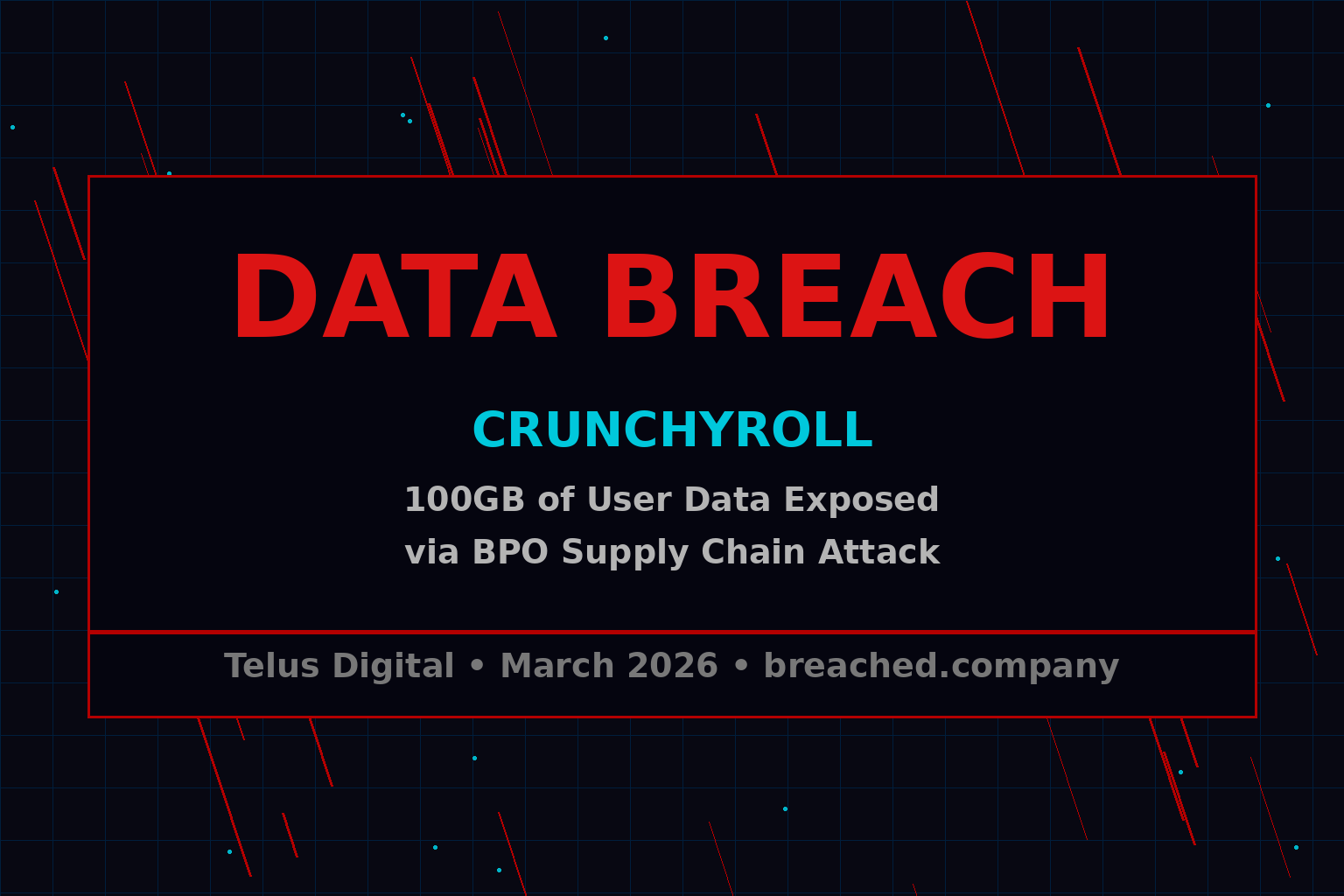
When 6.8 million anime fans signed up for Crunchyroll, they trusted Sony’s streaming platform with their names, email addresses, payment information, and viewing history. On March 12, 2026, that trust was broken — not through a sophisticated attack on Crunchyroll’s own systems, but through a single compromised employee at a third-party business process outsourcing (BPO) partner. The attacker exfiltrated approximately 100GB of customer data before access was revoked roughly 24 hours later. As of this writing, Crunchyroll has issued no public breach notification to affected users.
This is not a story about one company’s security failure. It’s a story about the most dangerous attack vector of 2026: the trusted third party.
What Happened: Inside the Crunchyroll Breach
According to threat actor communications reviewed by BleepingComputer and Cyber Security News, the intrusion began on March 12, 2026, at approximately 9 PM EST. The attacker gained their initial foothold by deploying malware on the workstation of a customer support agent employed by Telus Digital — the Canadian telecommunications giant’s BPO arm, which handles customer service operations for Crunchyroll and dozens of other major brands.
The malware infected the Telus employee’s machine and harvested credentials for the worker’s Okta Single Sign-On (SSO) account. With those credentials in hand, the attacker authenticated into Crunchyroll’s internal environment as a legitimate support representative — completely bypassing perimeter defenses because, from the systems’ perspective, it was a valid login from a trusted partner.
The breadth of access that single Okta account unlocked was alarming. According to screenshots reviewed by BleepingComputer, the compromised credentials granted entry to:
- Zendesk — Crunchyroll’s customer support ticketing platform
- Mixpanel — customer analytics and behavioral data
- Google Workspace Mail — internal email access
- MaestroQA — quality assurance for support interactions
- Jira Service Management — IT service desk and internal tickets
- Slack — internal team communications
- Wizer — security awareness training platform
That last one is particularly galling: the attacker had access to the platform Crunchyroll uses to train employees on cybersecurity.
Working quickly across these systems over the course of 24 hours, the threat actor downloaded 8 million support ticket records from Zendesk and exfiltrated an estimated 100GB of customer analytics data from Mixpanel and connected systems. The operation was deliberate and pre-planned. The attacker moved with speed and purpose, suggesting they had researched what systems were accessible before the initial intrusion.
Crunchyroll detected and revoked the attacker’s access approximately 24 hours after the initial breach on March 12th. By then, the damage was done.
What Data Was Exposed
The 100GB haul represents one of the largest customer data exfiltrations from a streaming platform in recent memory. Based on sample data analyzed by Cyber Digest and reviewed by BleepingComputer, the exposed records contain:
- Email addresses — confirmed for approximately 6.8 million unique users
- Full names and usernames
- IP addresses — allowing geographic inference of user locations
- General geographic location data
- Support ticket contents — including, in some cases, financial information users shared with support agents
- Credit card details — partial in most cases (last four digits, expiration dates), though the threat actor told BleepingComputer that a small subset of tickets contained full card numbers shared by users during support interactions
- Customer analytics data (PII) — behavioral profiles built from viewing patterns and platform interactions
It’s worth being precise here: the payment card exposure in this breach is primarily incidental rather than systemic. Crunchyroll does not appear to store full payment card numbers in its ticketing system. However, users who at any point messaged support and included card details — a frustratingly common practice — may have had those details exposed. The far greater risk for most affected users is the combination of email addresses, names, IP data, and support history, which together create a rich profile for targeted phishing campaigns and credential stuffing attacks.
The threat actor reportedly sent extortion demands to Crunchyroll, requesting $5 million in exchange for not publicly releasing the dataset. According to the attacker, those communications have been ignored.
Crunchyroll’s Response: Investigation Confirmed, Silence on Breach Notifications
Crunchyroll’s public response has been measured — perhaps too measured for the scale of what occurred.
When first contacted by BleepingComputer, the company confirmed awareness of the claims: “We are aware of recent claims and are currently working closely with leading cyber security experts to investigate the matter.”
In a follow-up statement, Crunchyroll added: “Our investigation is ongoing, and we continue to work with leading cybersecurity experts. At this time, we believe that the information is primarily limited to customer service ticket data following an incident with a third-party vendor. We have not identified evidence of ongoing access to systems in relation to these claims. We are continuing to monitor the situation closely.”
What Crunchyroll has notably not done is notify affected users. As of publication, there has been no email to the approximately 6.8 million individuals whose data appears in the stolen dataset, no blog post on the company’s security page, and no disclosure to regulators in jurisdictions that require breach notifications within defined timeframes — including the EU’s 72-hour GDPR notification window and California’s CCPA requirements.
The silence is doubly concerning given that Crunchyroll was already facing a class-action lawsuit in early 2026 over alleged unauthorized sharing of user viewing data with third-party marketing platforms — a separate matter, but one that suggests a pattern of insufficient transparency with users about how their data is handled.
Sony, which acquired Crunchyroll through its purchase of Funimation for $1.175 billion in 2021, has also not issued a public statement.
Why BPO Supply Chain Attacks Are the Defining Security Story of 2026
The Crunchyroll breach didn’t happen in a vacuum. It’s the latest — and perhaps the most prominent — example of what has become the dominant attack pattern of the past 18 months: using a trusted third party as a backdoor into a target organization.
BPO companies like Telus Digital occupy an extraordinarily privileged position in the enterprise security landscape. They handle customer support, billing operations, quality assurance, and content moderation for hundreds of companies simultaneously. To do their jobs, BPO employees require real access to production systems — ticketing platforms, analytics dashboards, email systems. That access is legitimate, granted intentionally, and often difficult to scope tightly without breaking the very workflows it enables.
For attackers, this creates an almost irresistible opportunity. Compromise one BPO employee, and you potentially have a key to dozens of companies.
The pattern has played out repeatedly in recent months:
Telus Digital itself was confirmed to have suffered a massive breach earlier this year, with the ShinyHunters extortion gang claiming theft of approximately one petabyte of data — reportedly the largest single exfiltration in history. BleepingComputer has confirmed that the Crunchyroll attack, while exploiting a Telus employee’s credentials, was a separate, unrelated incident from the ShinyHunters campaign. The fact that Telus Digital employees appear to have been targeted in at least two separate campaigns within the same period underscores just how attractive BPO workforce credentials have become.
Major UK retailers experienced similar BPO-adjacent compromises: Marks & Spencer confirmed attackers used social engineering against help desk staff to breach its networks, while Co-op disclosed data theft following a ransomware attack that similarly exploited support personnel access. The UK government issued specific guidance on social engineering attacks against help desks and BPOs in response.
Discord disclosed a data breach in late 2025 that exposed data from 5.5 million unique users after attackers compromised its Zendesk support system — eerily similar to the Crunchyroll attack vector.
Clorox suffered a costly network breach after attackers posed as an employee and convinced a Cognizant help desk agent to grant them access to internal systems.
The common thread is not a zero-day exploit or a sophisticated nation-state tool. It’s the patient exploitation of trust relationships between enterprises and their outsourced workforce partners — often combined with malware deployed on endpoint devices that may not meet the same security standards as the primary organization’s managed fleet.
The attack methodology continues to evolve. Where early BPO-targeting campaigns focused on social engineering and voice phishing (vishing) to extract credentials, the Crunchyroll attack demonstrates a shift toward endpoint malware targeting BPO employee machines — a vector that is harder to detect and doesn’t require the kind of human interaction that a well-trained employee might recognize and report.
What Affected Crunchyroll Users Should Do Now
If you have ever had a Crunchyroll account, you should treat your data as potentially compromised. Here’s what to do:
1. Change Your Crunchyroll Password Immediately
Use a strong, unique password that you don’t use on any other service. If you’re reusing your Crunchyroll password elsewhere — particularly for email — change it everywhere.
2. Enable Two-Factor Authentication
If you haven’t already, enable 2FA on your Crunchyroll account. Go to Settings → Account → Two-Step Verification. Use an authenticator app rather than SMS where possible.
3. Watch for Targeted Phishing Emails
With your name, email, and support ticket history in an attacker’s hands, expect highly personalized phishing attempts. Messages referencing specific support tickets you’ve opened with Crunchyroll, your subscription status, or your viewing history are red flags — Crunchyroll doesn’t need to “verify” your account via unsolicited email.
4. Monitor Your Payment Card
If you provided any card details (even partial) to Crunchyroll support at any point, monitor that card for unusual activity. Consider requesting a replacement card from your bank as a precaution, particularly if you ever shared full card details in a support conversation.
5. Check Your Email for Data Breach Notifications
Crunchyroll is legally obligated under GDPR, CCPA, and similar regulations to notify users whose PII was compromised. Watch for an official breach notification email — and verify it’s genuine before clicking any links.
6. Use a Breach Monitoring Service
Services like Have I Been Pwned (haveibeenpwned.com) track when credentials appear in known breach datasets. Sign up for alerts tied to your Crunchyroll email address.
Broader Implications: Streaming Platforms and Entertainment Security
The entertainment industry’s security posture has long been considered a step behind sectors like finance and healthcare — industries that face heavier regulatory scrutiny and have invested accordingly in security controls. The Crunchyroll breach may accelerate a reckoning that’s been building for years.
Streaming platforms handle vast quantities of sensitive user data: not just payment information, but behavioral profiles built from years of viewing history, device fingerprints, location data, and support interactions. That data has real value to advertisers, data brokers, and threat actors alike. Yet the security investment in protecting it often reflects the entertainment industry’s historic tendency to prioritize content security (anti-piracy) over customer data security.
The supply chain dimension compounds the problem. Streaming platforms operate globally with lean teams, relying heavily on outsourced operations for customer support, content moderation, and data operations. Each BPO relationship is a trust extension — and potentially a vulnerability. The question companies need to ask is not just “how secure is our network” but “how secure is every person and system we’ve granted access to it?”
For Crunchyroll specifically, the questions that need answers — and that Sony should be compelled to answer publicly — include:
- Why did a single BPO employee’s Okta account have simultaneous access to Zendesk, Mixpanel, Google Workspace, Slack, and Jira?
- What endpoint security requirements does Telus Digital’s contract with Crunchyroll specify for machines accessing production systems?
- Why was 24 hours sufficient for an attacker to download 100GB of data before access was revoked?
- When will affected users receive formal breach notifications?
The BPO supply chain attack is not a novel concept — security researchers have warned about this vector for years. What’s changed in 2026 is the industrialization of the technique: attackers have become proficient at identifying, targeting, and monetizing BPO access at scale. Every company with outsourced operations should treat this as a wake-up call.
For Crunchyroll’s 6.8 million affected users, the call came too late. For every other company whose workforce is distributed across BPO partners, the time to act is now.
This article is based on reporting from BleepingComputer, Cyber Security News, and the International Cyber Digest. Crunchyroll has confirmed an investigation is ongoing. BleepingComputer reviewed samples of the stolen data. Breached Company will update this article as the investigation develops.