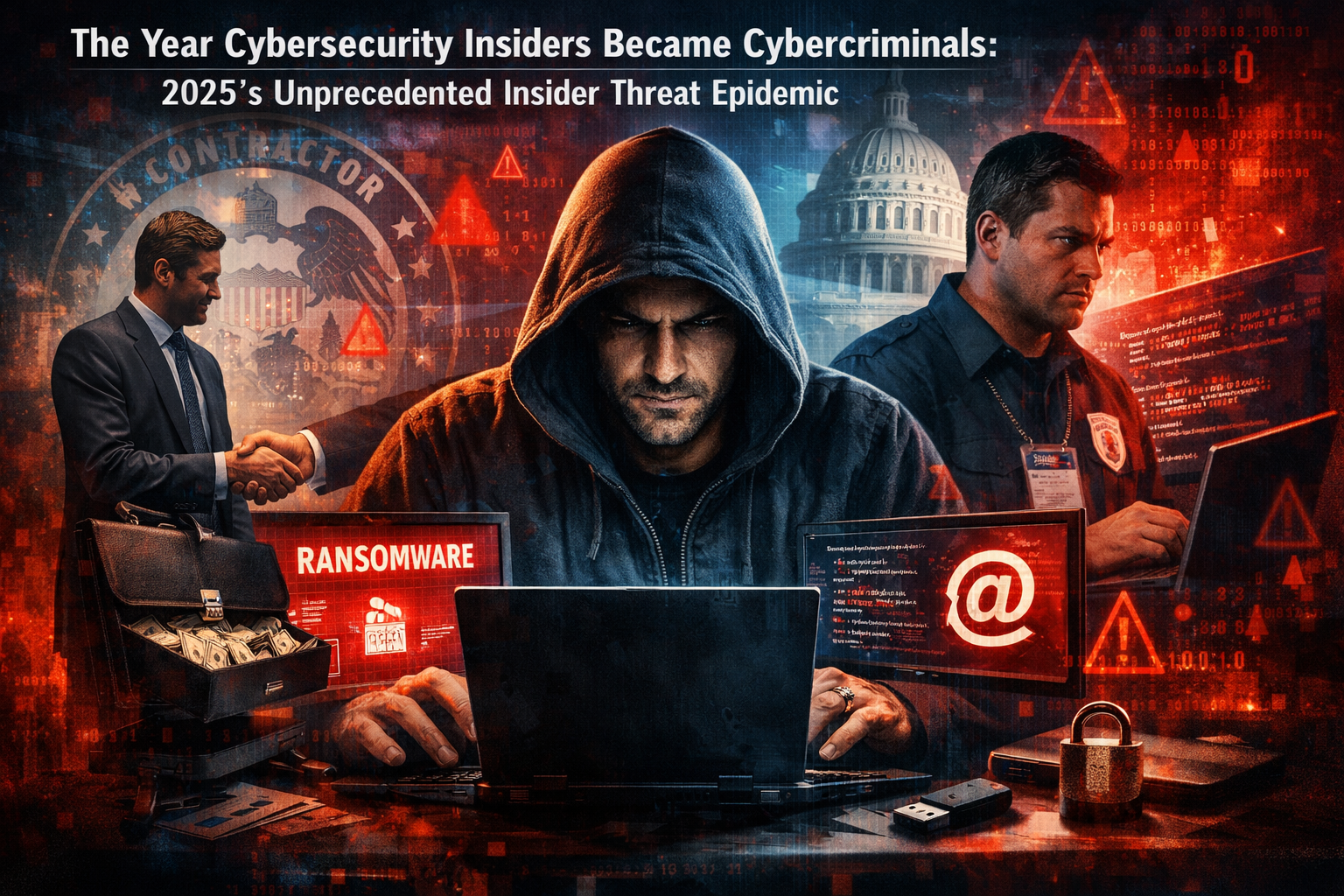
From ransomware negotiators to exploit developers to federal contractors, 2025 exposed a disturbing pattern of trusted security professionals weaponizing their access against the very organizations they were hired to protect.
December 19, 2025
Executive Summary
The year 2025 will be remembered as a watershed moment in cybersecurity history—not for external threats, but for an unprecedented wave of insider attacks perpetrated by the very professionals entrusted with defending against cybercrime. From December’s guilty pleas by ransomware negotiators who became ransomware operators, to October’s arrest of an L3Harris executive selling exploits to Russia, to April’s cybersecurity CEO caught planting malware in a hospital, the year exposed fundamental vulnerabilities in how the industry vets, monitors, and trusts its own practitioners.
This comprehensive investigation examines five major insider threat cases from 2025, revealing common patterns of financial motivation, abuse of privileged access, sophisticated cover-up attempts, and devastating breaches of professional ethics. Together, these cases compromised national security secrets, deleted federal databases, exposed millions in healthcare data, and fundamentally challenged the trust model underlying cybersecurity operations.
As detailed in our recent coverage of Ryan Goldberg and Kevin Martin’s guilty pleas, these incidents are not isolated aberrations but symptoms of systemic weaknesses in insider threat detection, background screening, and professional accountability within the cybersecurity industry.
INTERACTIVE TOOL: Assess your organization’s insider threat vulnerabilities with our Insider Threat Matrix - a comprehensive framework for identifying and mitigating internal security risks.
Case 1: Peter Williams - The Exploit Broker (October 2025)
The Crime: Selling America’s Cyber Weapons to Russia
On October 29, 2025, Peter Williams, the 39-year-old former general manager of L3Harris Trenchant, pleaded guilty to two counts of theft of trade secrets for selling eight highly classified zero-day exploits to Operation Zero, a Russian cyber weapons broker known to supply the Russian government. The case represents one of the most significant breaches of Western offensive cyber capabilities in recent history.
The Perpetrator: From Australian Spy to Russian Asset
Williams, known internally as “Doogie,” brought impeccable credentials to his betrayal:
- Australian Signals Directorate (ASD): Worked for Australia’s premier signals intelligence agency from approximately 2007 to the mid-2010s
- Linchpin Labs: Joined the Australian zero-day development firm before its acquisition by L3Harris
- L3Harris Trenchant: Rose to general manager with “super-user access” to the company’s most sensitive systems
- Five Eyes Trust: Had access to exploit development for the US, UK, Canada, Australia, and New Zealand intelligence alliance
This background made Williams one of the most trusted individuals in Western offensive cybersecurity—and one of the most dangerous when he turned.
 Breached CompanyBreached Company
The Theft: Air-Gapped Networks Breached by Portable Hard Drives
Williams’ method demonstrates how insider access trumps even the most sophisticated security controls:
The Technical Execution:
- Exploited his “super-user” access to Trenchant’s “internal, access-controlled, multi-factor authenticated” secure network
- Used portable external hard drives to transfer exploits from air-gapped systems in Sydney and Washington, D.C., offices
- Copied files to personal devices before transmitting via encrypted channels to Russian broker
- Operated under the alias “John Taylor” for all communications
The Scope:
- Eight zero-day exploits stolen between April 2022 and June 2025
- Exploits worth $35 million on the gray market
- Williams received only $1.3 million in cryptocurrency—a massive discount suggesting desperate financial circumstances
The Contracts: Williams entered into formal written agreements with Operation Zero, including:
- Upfront payments upon verification that exploits worked
- $10,000 monthly follow-on support contracts for at least three months
- One December 2023 contract promised $2 million for a single exploit (matching Operation Zero’s public bug bounty)
- Periodic payments contingent on exploits remaining effective after software patches
The Cover-Up: Framing an Innocent Employee
Perhaps most disturbing was Williams’ attempt to deflect suspicion:
February 2025 - The Scapegoat:
- Trenchant discovered that Chrome zero-day exploits had leaked
- Williams, leading the internal investigation, called a developer into the London office under the pretense of a “team-building exercise”
- Confronted the employee via video call, accused him of “moonlighting” for another company
- Seized the employee’s electronics and suspended him
- Subsequently fired him for allegedly stealing Chrome exploits
The Developer’s Defense:
- The fired employee had worked exclusively on iOS exploits and spyware
- He had no access to Chrome zero-day development (teams were compartmentalized)
- Former colleagues corroborated his account
- Apple later notified him that his iPhone had been targeted by “mercenary spyware attack”—suggesting Williams may have targeted him
The Timeline Reveals the Lie: Months after firing the innocent employee in February, Williams continued his crimes:
- June 2025: Signed contract to sell stolen code for $500,000 to Russian broker
- Days Later: Met with FBI to discuss their investigation into Trenchant code theft
- Throughout: Sold at least one more exploit even after learning his previous tools were being “utilized” by a South Korean broker
The Downfall: Caught by AI Queries and Luxury Purchases
August 2025 - The Confession: During FBI interrogation, Williams admitted to agents that:
- He was recruited to sell exploits to escape personal financial difficulties
- The “most likely way” to steal from secure networks was using air-gapped devices (exactly his method)
- Code he had written and sold to the Russian broker was being used by other downstream brokers
- At least two of the exploits he sold caused approximately $35 million in losses to Trenchant
The Evidence Trail: Prosecutors built their case on:
- Cryptocurrency transaction records totaling $1.3 million
- Communications via encrypted apps and foreign email services
- Luxury purchases including high-end watches, designer clothing, and jewelry
- Testimony from the wrongfully terminated employee
- Technical forensics from Trenchant’s secure networks
The Impact: Arming America’s Adversaries
The consequences extend far beyond the immediate $35 million loss:
National Security Implications:
- Eight sophisticated zero-day exploits now in Russian hands
- Tools designed for Five Eyes intelligence operations compromised
- Unknown number of victims already targeted using stolen capabilities
- Potential exposure of Western intelligence collection methods
Operation Zero’s Business Model: The Russian broker Williams sold to operates as:
- A marketplace for zero-day exploits serving “non-NATO buyers”
- Supplier to Russian government agencies and contractors
- Founded by former Kaspersky Lab researcher Sergey Zelenyuk
- Advertises publicly for exploit submissions with substantial bounties
Downstream Proliferation: Williams admitted knowing that his exploits were being resold to additional brokers, meaning:
- South Korean broker acquired at least one of his tools
- Unknown additional countries may have purchased capabilities
- Secondary markets ensure exploit lifespans extend indefinitely
- Attribution of future attacks using these tools becomes nearly impossible
The Sentencing: January 2026
Williams faces:
- Maximum: 10 years per count (20 years total)
- Federal Guidelines: 87-108 months (7.25-9 years)
- Mandatory Fines: Up to $300,000
- Restitution: $1.3 million to Trenchant
- Forfeiture: All luxury items purchased with ill-gotten gains
Judge Loren AliKhan will determine the final sentence in January 2026. Home confinement pending sentencing reflects both flight risk concerns and the gravity of the charges.
Industry Implications: The Exploit Developer Dilemma
The Williams case exposes fundamental tensions in offensive security:
The Trust Paradox:
- Companies need highly skilled exploit developers
- Those developers must have access to the most sensitive capabilities
- The same access that makes them valuable makes them dangerous
- Air-gapped networks and access controls failed against determined insider
The Talent Pipeline Problem:
- Many exploit developers have intelligence agency backgrounds
- Government agencies can’t retain all talent due to pay disparities
- Private sector needs these experts but can’t replicate government vetting
- Five Eyes alliance relies on private contractors like Trenchant
The Compartmentalization Failure: Even strict team segregation failed because:
- Williams had broad access as general manager
- Executive positions require visibility across projects
- Technical controls couldn’t prevent physical theft via external drives
- Trust model assumed executives were beyond suspicion
Case 2: Jeffrey Bowie - The Hospital Hacker (April 2025)
The Crime: CEO Caught Planting Surveillance Malware
On April 14, 2025, Jeffrey Bowie, CEO of Oklahoma cybersecurity firm Veritaco, was arrested for installing malware on computers at SSM Health’s St. Anthony Hospital in Oklahoma City. Security cameras captured him wandering through the 773-bed facility, attempting to access multiple offices before successfully installing surveillance software designed to capture and exfiltrate screenshots every 20 minutes.
The Perpetrator: Cybersecurity CEO Turned Cybercriminal
Professional Background:
- Veritaco: Founded August 2023, described as “cybersecurity, digital forensics, and private intelligence firm”
- 7 Alkaloids LLC: Also CEO of this natural health supplements company (founded December 2024)
- High Point Networks: Previously Senior Cyber Security Engineer (North Dakota)
- Lodestone: Security Engineer (Oklahoma City)
- Clevyr: Software Engineer for application development firm
- Alias Cyber Security: Worked 2020-2021 in Yukon, Oklahoma
The Red Flag: Alias Cyber Security CEO Donovan Farrow told local news station KOKO 5 that he “wasn’t surprised” when he heard about Bowie’s arrest, having previously let him go “due to ethics concerns.” This raises critical questions about background checks and information sharing within the security industry.
The Incident: August 6, 2024
Timeline of Events:
5:00 PM: Bowie enters St. Anthony Hospital, claims to staff he has a family member undergoing surgery
5:00-5:10 PM: Security cameras capture Bowie:
- Wandering through hospital corridors
- Attempting to enter multiple offices
- Checking doors and looking for unattended computers
- Eventually finding two computers, one designated for staff only
5:10 PM: Bowie accesses employee computers and installs malware
~5:20 PM: Hospital staff member notices Bowie using an employee computer and confronts him
Immediate Response: Bowie repeats claim about family member needing computer access; staff alerts security
Post-Incident: Hospital IT team conducts forensic analysis
The Malware: Screenshot Surveillance
Technical Specifications:
- Type: Custom surveillance malware (specific variant not disclosed)
- Function: Automated screenshot capture every 20 minutes
- Exfiltration: Transmitted images to external IP address
- Design: Purpose-built for persistent monitoring, not ransomware or data theft
What It Could Capture:
- Electronic Health Records (EHR) displays
- Protected Health Information (PHI)
- Staff login credentials
- Internal hospital communications
- Patient billing information
- Medication administration records
- Scheduling and staffing data
What Was Actually Compromised: According to SSM Health’s statement, the swift detection and response meant:
- No patient information was accessed
- Systems remained secure
- Malware was contained before successful exfiltration
- Hospital operations continued without disruption
The Investigation: Swift Action Prevented Disaster
Hospital Response:
- Immediate: Security alerted, Bowie removed from premises
- Within Hours: IT security team initiated forensic review
- Forensic Discovery: Confirmed malware installation on affected computers
- April 14, 2025: Police issued arrest warrant (8+ months after incident)
Law Enforcement Involvement:
- Oklahoma City Police Department (lead agency)
- FBI (federal involvement due to healthcare cybersecurity implications)
- Joint investigation into potential HIPAA violations
- Review of whether attack was targeted or opportunistic
The Charges and Potential Penalties
Filed Charges:
- Count 1: Violating Oklahoma Computer Crimes Act (installation of malicious software)
- Count 2: Violating Oklahoma Computer Crimes Act (unauthorized access to protected systems)
Potential Sentences:
- If Prosecuted as Misdemeanor: Up to $5,000 fine + 30 days jail per count
- If Prosecuted as Felony: $5,000-$100,000 fine + up to 10 years prison per count
- HIPAA Violations: Additional federal charges possible if patient data accessed
Given the premeditated nature (bringing malware on physical media), targeting of healthcare facility, and attempted cover story, felony prosecution appears likely.
The Mystery: What Was the Motive?
Unlike most 2025 insider cases, Bowie’s motive remains unclear:
Possible Explanations:
1. Corporate Espionage:
- Gathering intelligence for competing healthcare cybersecurity contracts
- Attempting to demonstrate hospital vulnerabilities for sales pitch
- “Proof of concept” for incident response services
2. Extortion Plan:
- Stage 1: Plant surveillance malware (caught here)
- Stage 2: Gather sensitive data over weeks/months
- Stage 3: Extortion demand or ransomware deployment
3. Personal Vendetta:
- Unknown relationship with St. Anthony Hospital
- Possible grudge against SSM Health system
- Retaliation for contract dispute or rejection
4. Testing/Research:
- Illegal “penetration test” without authorization
- Attempting to build case study for his firm
- Reckless “research” for cybersecurity presentations
The investigation has not publicly revealed Bowie’s motive, making this case particularly concerning—we don’t know what he intended to do with the screenshots.
The Business Collapse: Veritaco Disappears
Post-Arrest Aftermath:
- Veritaco’s website became unreachable by late April 2025
- Company’s LinkedIn page remained but showed no activity
- 7 Alkaloids LLC website also went offline
- No public statement from Veritaco about the arrest
- Employees and clients abandoned the firm
Market Impact:
- Oklahoma cybersecurity community faced reputation damage
- Small firms struggled to prove trustworthiness after high-profile CEO arrest
- Healthcare organizations increased scrutiny of security vendor access
- Industry calls for better vetting of security company principals
Case Status: Awaiting Trial
As of December 2025:
- Bowie has not publicly entered a plea
- Trial date not yet set
- No additional charges filed
- Hospital confirmed no additional incidents discovered
- FBI investigation continues into broader potential targeting
Related: The Bowie case mirrors other contractor insider threats from 2025, including a Google contractor who systematically exfiltrated nearly 2,000 screenshots of sensitive Play Store infrastructure, demonstrating how contractor access creates critical attack vectors even at major tech companies.
Lessons from the Bowie Case
Red Flags That Were Missed:
- Previous employer (Alias Cyber Security) fired him for “ethics concerns” but information didn’t follow him
- Founded new firm immediately after departure from previous employer
- Simultaneously running health supplements company—divided focus or cover operation?
- Website and social media presence typical of legitimate firm—good operational security
What Hospitals Should Learn:
- Physical security failures allowed unauthorized office access
- Employee computers should require authentication even when in secure areas
- Visitor management systems need better integration with security monitoring
- “Family member in surgery” claim should trigger verification
- Rapid forensic response limited damage—but prevention would have been better
Industry-Wide Implications:
- Background checks don’t capture “ethics concerns” from previous employers
- Security industry lacks formal professional licensing that would track misconduct
- Small firms (2-10 employees like Veritaco) face less scrutiny than large contractors
- Healthcare organizations are uniquely vulnerable to insider/vendor attacks
Case 3: The Akhter Twins - Repeat Offenders (December 2025)
The Crime: Revenge of the Convicted Hackers
On December 3, 2025, twin brothers Muneeb and Sohaib Akhter, both 34, of Alexandria, Virginia, were arrested for allegedly stealing and destroying government data held by federal contractor Opexus—minutes after being fired from the company. The February 2025 incident compromised data from multiple federal agencies including DHS, IRS, and EEOC, and represents one of the most audacious insider attacks against U.S. government infrastructure in recent history.
The Perpetrators: A Decade of Cybercrime
Criminal History - 2014-2015:
2014 Hirings:
- Muneeb Akhter: Hired in IT role at Department of Homeland Security
- Sohaib Akhter: Hired through contractor for State Department work
The First Betrayal: The brothers used their government access to:
- Download troves of sensitive information from DHS and State Department
- Hack into Maryland-based private data aggregation company
- Access federal contract bidding information to advantage their technology company
- Attempt to install electronic collection device inside State Department office
2015 Convictions:
- Muneeb: Pleaded guilty, sentenced to 39 months (3.25 years) in prison
- Sohaib: Pleaded guilty, sentenced to 24 months (2 years) in prison
- Charges: Wire fraud, conspiracy to hack into U.S. State Department
- Additional: Muneeb served extra time for violating supervised release terms
The Unthinkable Second Chance:
After serving their prison sentences, both brothers secured employment with Opexus, a Washington D.C.-based federal contractor that:
- Provides software services to 45+ federal agencies
- Manages eCASE system for government agency audits
- Operates FOIAXpress, tracking Freedom of Information Act requests
- Handles highly sensitive investigative files and documents
- Processes EEOC discrimination complaints and IRS tax data
- Has received $50+ million in government contracts over past decade
How Did Convicted Hackers Get Security Jobs?
Opexus admits catastrophic failures in hiring process:
- Conducted “seven-year background checks” that somehow missed 2015 federal convictions
- Brothers’ names and crimes were widely reported and easily searchable via Google
- No secondary verification of criminal history databases
- Hired Muneeb in 2023, Sohaib in 2024—less than a decade after their federal convictions
- Did not discover criminal histories until February 2025 (details unclear how they finally learned)
The Attack: February 18-25, 2025
Timeline of Destruction:
February 18, 2025 - 1:50 PM: FDIC flags the Akhter twins as potential security threats based on their criminal records, notifying Opexus
1:50-5:00 PM: Opexus management decides to terminate both brothers
5:14 PM: Brothers are aware they’re about to be fired
- Sohaib: “They’re gonna probably raid this place”
- Muneeb: “I’ll clean this shit up”
- Sohaib: “We also gotta clean stuff up from the other house, man”
(This conversation was captured by Opexus surveillance or law enforcement wiretap)
5:50 PM: Company fires both brothers
5:55 PM: Sohaib attempts to access Opexus network
- VPN connection fails (already deactivated)
- Windows account disabled
- Attempt blocked by IT security protocols
5:56 PM: Muneeb still connected to network, begins attack
- Accessed government agency database
- Issued SQL commands to lock out other users
- Prevented others from modifying database
- Executed deletion commands
5:57-6:00 PM: First databases deleted
February 18-25 (One Week Rampage):
Muneeb systematically destroyed federal data:
- 96 databases deleted containing U.S. government information
- Databases included Freedom of Information Act records
- Sensitive investigative files from multiple agencies
- DHS production database eliminated
- IRS tax information on 450+ individuals stolen
- EEOC discrimination complaint files compromised
The AI-Assisted Cover-Up
Muneeb’s AI Queries:
One minute after deleting DHS database:
- Query: “how do i clear system logs from SQL servers after deleting databases”
- Shows premeditation and sophisticated understanding of forensic anti-detection
Later that evening:
- Query: “how do you clear all event and application logs from Microsoft windows server 2012”
- Attempting to eliminate evidence of unauthorized access and destruction
The Irony: Using AI to help commit cybercrime while government agencies develop AI policies to detect insider threats highlights the arms race between attackers and defenders.
The Data Theft: Stolen Federal Records
Beyond destruction, Muneeb exfiltrated sensitive data:
From EEOC (Equal Employment Opportunity Commission):
- Obtained approximately 1,800 files without authorization after termination
- Files contained discrimination complaints against federal agencies
- Included personal information of complainants and respondents
- Potentially revealed internal agency investigative techniques
From IRS (Internal Revenue Service):
- Copied data stored on virtual machine
- Federal tax information on at least 450 people
- Personally identifiable information (names, addresses, SSNs)
- Financial data that could enable identity theft or fraud
Sohaib’s Role:
- Trafficking in password for EEOC Opexus computer access
- Password could “access a computer used by or for the government of the United States”
- Potentially intended to sell access or maintain backdoor entry
The Cover-Up Attempt: Wiping Evidence
Laptop Destruction:
- Both brothers wiped company-issued laptops before returning them
- Reinstalled operating system to eliminate forensic traces
- Deleted logs, emails, and any evidence of unauthorized access
- Attempted to make investigation more difficult
Home Cleanup:
- Discussion captured about cleaning “this place” and “the other house”
- Suggests they maintained equipment or data at multiple locations
- May have had offline backups of stolen data
- Preparation for law enforcement raid that they correctly anticipated
The Agencies Affected
Department of Homeland Security (DHS):
- Production databases deleted
- Investigative files compromised
- Uncertain extent of damage to ongoing investigations
- Prior 2014 breach by same individuals at DHS makes this personal
Internal Revenue Service (IRS):
- Tax information on 450+ individuals stolen
- Virtual machine data copied
- Potential for downstream identity theft and fraud
- Tax fraud schemes possible using stolen data
Equal Employment Opportunity Commission (EEOC):
- 1,800+ discrimination complaint files accessed
- Password for Opexus EEOC systems trafficked
- Ongoing investigations potentially compromised
- Complainants’ confidential information exposed
General Services Administration (GSA):
- Databases deleted during attack
- Records and documents lost
- FOIA processing disrupted
Multiple Other Agencies:
- Opexus serves 45+ federal agencies total
- Full extent of compromise unclear
- FOIA requests disappeared across government
- Agencies scrambling to reconstruct lost data
The Investigation and Charges
November 13, 2025: Grand jury returns indictment
December 3, 2025: Arrests in Alexandria, Virginia
Muneeb Akhter Charges:
- Conspiracy to commit computer fraud and to destroy records
- Two counts of computer fraud
- Theft of U.S. government records
- Two counts of aggravated identity theft
Potential Sentence:
- Mandatory minimum: 4 years (identity theft)
- Maximum: 45 years total
- Each charge carries separate penalties
Sohaib Akhter Charges:
- Conspiracy to commit computer fraud and to destroy records
- Computer fraud (password trafficking)
Potential Sentence:
- Maximum: 6 years
Prosecuting Agencies:
- U.S. District Court for the Eastern District of Virginia
- More than 20 federal agencies assisted investigation
- DOJ Criminal Division leading prosecution
- FBI cyber division conducting forensics
Opexus’s Failures and Response
What Went Wrong:
Hiring Failures:
- Background checks missed publicly available federal conviction records
- No verification against PACER (federal court records database)
- No Google search of applicants’ names (would have revealed extensive media coverage)
- Hired both brothers despite being convicted federal cybercriminals
- Timeline suggests urgency in hiring overrode proper vetting
Termination Failures:
- Decided to fire brothers but didn’t immediately revoke all access
- Five-minute window between firing decision and actual termination
- Muneeb remained connected to network during critical period
- No “kill switch” to instantly revoke all permissions
- Poor coordination between HR, IT security, and management
Access Control Failures:
- Employees had excessive permissions for their roles
- Same username/password used across multiple databases (per Sohaib’s leaked email)
- No principle of least privilege implementation
- Databases stored insecurely according to the brothers
- Insufficient monitoring of privileged access
Company Statement - December 2025:
“The security of our customers’ information is our highest priority and we are thankful that these individuals are being held accountable. We will continue to fully support the process as it moves forward, just as we have supported our customers since the incident occurred. We have learned a great deal from this incident and have taken meaningful steps to strengthen the security of the information we handle, now and in the future, and we remain committed to supporting our customers’ critical needs with best-in-class security and service.”
Translation: Opexus admits failures but emphasizes cooperation with law enforcement and implementation of new security measures. The company survived this incident but faces potential loss of federal contracts and civil lawsuits from affected individuals.
The Broader Impact
FOIA System Disruption:
- Hundreds of Freedom of Information Act requests disappeared
- Government agencies couldn’t respond to pending requests
- Legal deadlines missed for FOIA compliance
- Public records access disrupted for months
- Reconstruction of deleted data incomplete
Federal Agency Operations:
- Multiple agencies scrambled to recover lost investigative files
- Ongoing cases potentially compromised by database deletions
- Interagency cooperation on cases disrupted
- Unknown whether criminals benefited from destruction of evidence
Trust in Federal Contractors:
- Congress questioning contractor vetting processes
- Calls for mandatory reporting of contractor cybersecurity incidents
- Review of background check requirements for sensitive data access
- Potential legislation requiring clearances for federal contractor IT staff
Related Government Contractor Issues: The Akhter case highlights broader systemic problems in federal contractor oversight, echoed by the DOGE SSA data security breach, where questions about foreign nationals and offshore development practices accessing sensitive federal data exposed inadequate vetting and security controls across government contracting.
Identity Theft Risk:
- 450+ individuals whose IRS data was stolen face ongoing risk
- EEOC complainants worried about retaliation if identities exposed
- Government offering credit monitoring but damage potentially ongoing
- Class action lawsuits likely against Opexus
Lessons from the Akhter Case
The Repeat Offender Problem: This case starkly demonstrates that:
- Convicted cybercriminals often reoffend when given access
- Prison sentences don’t necessarily rehabilitate cyber attackers
- Background checks are only as good as the databases they query
- Industries must share information about terminated employees’ misconduct
- Second chances are appropriate in many cases—but not for handling federal data
The Insider Threat Window: The five-minute gap between firing decision and access revocation enabled massive damage:
- Instant access revocation protocols essential
- Separation of duties: HR shouldn’t notify IT, IT should monitor for termination triggers
- Automated systems can revoke access faster than humans
- High-risk terminations require special procedures
Related Insider Revenge Cases:
- Former IT contractor Maxwell Schultz caused $862,000 in damages through a revenge hack, resetting 2,500 passwords after termination
- CrowdStrike terminated an employee who allegedly sold screenshots to Scattered Lapsus$ Hunters, demonstrating even security-focused organizations face insider risks
The Database Security Failure: Shared credentials across databases represented catastrophic security design:
- Each user should have individual accounts for audit trails
- Privileged access should require multi-factor authentication
- Database-level access controls should prevent mass deletion
- Backup systems should be immutable and air-gapped
The AI Complication: Attackers now use AI to:
- Plan sophisticated attacks in real-time
- Cover tracks more effectively
- Automate reconnaissance and exploitation
- Adapt tactics based on AI-generated advice
Defenders must leverage AI for threat detection faster than attackers use it for evasion.
Case 4: Matthew Lane - The PowerSchool Extortionist (October 2025 Sentencing)
The Crime: Largest Breach of American Schoolchildren’s Data
Matthew Lane was sentenced to four years in federal prison on October 15, 2025, for orchestrating what authorities describe as the single largest breach of American schoolchildren’s data on record. The 29-year-old hacker accessed PowerSchool’s systems using stolen contractor credentials in September 2024, compromising sensitive information on tens of millions of K-12 students across the United States.
The Attack: Contractor Credentials Enable Massive Breach
Timeline:
September 2024: Lane obtains PowerSchool contractor’s credentials
- Method of credential theft not publicly disclosed
- Possible phishing, credential stuffing, or dark web purchase
- Contractor had legitimate access to PowerSchool infrastructure
September 2024: Unauthorized access and data exfiltration
- Gained entry to PowerSchool’s production systems
- Downloaded massive troves of student records
- Accessed data from thousands of school districts nationwide
- Collected names, addresses, grades, attendance, discipline records
December 2024: Ransom demand delivered
- Lane threatened to release student data publicly
- Demanded $2.9 million in cryptocurrency (valuation at time)
- Set deadline for payment with threat of data publication
- Contacted PowerSchool directly with extortion demands
December 2024 - May 2025: Downstream extortion attempts
- Multiple school districts received separate extortion demands
- Different threat actors claimed access to same data
- Suggested Lane sold/shared data with accomplices
- Created cascading extortion crisis across educational sector
The Data Compromised
Scope of Breach:
- Tens of millions of K-12 students affected
- Data from thousands of school districts using PowerSchool
- Records spanning multiple school years
- Considered largest educational data breach in U.S. history
Types of Information Exposed:
- Student names, addresses, dates of birth
- Social Security numbers (in some districts)
- Academic records, grades, test scores
- Attendance and discipline records
- Special education accommodations
- Medical information (in some cases)
- Parent/guardian contact information
- Financial data (lunch program eligibility, fees owed)
Long-Term Impact: Unlike adults whose data is breached, children face:
- Decades of identity theft risk before they even have credit
- Potential discrimination based on early discipline records
- Exposure of sensitive medical/educational accommodations
- No ability to protect themselves at age of breach
- Data that will follow them into college applications, job searches
PowerSchool’s Market Position
Company Background:
- Leading provider of K-12 education technology and SIS (Student Information Systems)
- Serves thousands of school districts across all 50 states
- Holds data on estimated 45+ million students
- Trusted partner for educational institutions nationwide
- Handles everything from enrollment to grades to attendance
Why PowerSchool Was Targeted:
- Centralized database representing aggregated value
- One breach reaches thousands of schools simultaneously
- Educational institutions often have limited cybersecurity budgets
- Student data has long-term value for identity thieves
- Districts under pressure to pay quickly to protect children
The Investigation and Arrest
Law Enforcement Response:
- FBI Cyber Division led investigation
- Coordinated with Department of Education
- Worked with PowerSchool’s internal security team
- Traced cryptocurrency wallet transactions
- Identified Lane through digital forensics and threat intelligence
The Arrest:
- Lane apprehended by federal authorities
- Charged with computer fraud, wire fraud, and extortion
- Faced additional state charges from affected districts
The Sentencing: October 15, 2025
Judge’s Decision:
- 4 years (48 months) in federal prison
- Significantly below maximum possible sentence
- Reflected cooperation and specific case circumstances
Financial Penalties:
- Forfeited: $161,000 traced directly to crimes
- Unaccounted: $3 million in illicit proceeds missing
- Government Position: “The money he returned is barely one percent of the financial loss he caused”
- Restitution: Amount not publicly disclosed but likely substantial
Where’s the Missing $3 Million? Prosecutors’ statement raises troubling questions:
- Did Lane spend it before arrest?
- Hidden in cryptocurrency wallets?
- Distributed to accomplices?
- Converted to untraceable assets?
- Moved to offshore accounts?
The massive disparity between forfeited and total proceeds suggests either sophisticated money laundering or accomplices who profited from the scheme.
The Downstream Extortion Wave
May 2025 Revelation: PowerSchool disclosed that “multiple school district customers received follow-on extortion demands linked to the stolen same data.” This indicates:
Secondary Threat Actors:
- Lane either sold the data before his arrest
- Shared data with criminal associates
- Data leaked to dark web forums
- Other hackers claimed access (true or bluff)
District-Level Chaos: Individual school districts faced:
- Separate ransom demands after PowerSchool incident
- Uncertainty whether paying would stop additional demands
- Pressure from parent groups and media
- Legal liability for failing to protect student data
- No way to verify if extortionists actually had unique data
The Cascading Effect: This multi-stage extortion demonstrates how:
- One initial breach creates ongoing victimization
- Data continues generating revenue for criminals long after initial attack
- Victims can’t “end” exposure by paying one ransom
- Educational institutions face repeated targeting
- Children’s data has perpetual value to criminals
The Broader Educational Cybersecurity Crisis
Systemic Vulnerabilities:
Underfunded IT Security:
- School districts allocate minimal budget to cybersecurity
- Educational technology vendors face price pressure
- Security often sacrificed for cost and ease of use
- K-12 IT staff typically understaffed and overworked
Attractive Target Profile:
- Massive amounts of sensitive data
- Limited security resources
- High pressure to pay (protecting children)
- Multiple entry points (districts, vendors, third-parties)
- Long-term value of children’s data
Regulatory Gap:
- FERPA (Family Educational Rights and Privacy Act) predates modern cyber threats
- Weak enforcement and penalties
- No mandatory breach disclosure timelines
- Insufficient security requirements for vendors
Industry Response Post-Lane
PowerSchool’s Actions:
- Enhanced multi-factor authentication requirements
- Improved contractor access vetting and monitoring
- Increased security team staffing
- Regular third-party security audits
- Student data encryption upgrades
Broader Industry Changes:
- Educational technology vendors reviewing credential management
- School districts demanding stronger security SLAs (Service Level Agreements)
- Federal government considering updated FERPA regulations
- Cyber insurance policies for educational institutions becoming mandatory
Lessons from the Lane Case
Contractor Credential Security: The breach highlights that:
- Third-party contractors represent high-value targets
- Stolen contractor credentials provide “legitimate” access
- Systems often cannot distinguish authorized from compromised accounts
- Principle of least privilege essential for all third-party access
Student Data Protection: Children deserve special protection:
- Higher security standards for systems holding children’s data
- Enhanced penalties for breaches affecting minors
- Mandatory notification to families within days, not months
- Free identity monitoring should be automatic, not negotiated
The Multi-Stage Extortion Problem: One breach can create:
- Initial ransom to attacker
- Secondary ransom to data purchasers
- Tertiary extortion from opportunistic criminals claiming (falsely) to have data
- Ongoing blackmail as data resurfaces over time
The Missing Money: $3 million unaccounted for raises questions about:
- Adequacy of financial investigation
- Whether accomplices remain at large
- If seized funds should be used for victim remediation
- How to trace and recover cryptocurrency proceeds
Current Status
Lane’s Imprisonment:
- Serving 48-month sentence in federal facility
- Expected release approximately 2028-2029
- Subject to supervised release upon completion
- Lifetime ban from working with children’s data likely
Ongoing Impact:
- Affected students’ data remains in criminal hands
- School districts continue to face related lawsuits
- Parents pursuing class actions against PowerSchool and districts
- Identity theft monitoring ongoing for millions of children
Investigative Continuity:
- FBI continuing to pursue additional suspects tied to downstream extortion
- Efforts to identify who purchased/received stolen data
- International cooperation to trace cryptocurrency flows
- Potential additional arrests anticipated
Case 5: Ryan Goldberg & Kevin Martin - The Ransomware Negotiators (December 2025)
For complete details on this case, see our comprehensive coverage: Cybersecurity Insiders Plead Guilty: When the Defenders Become Attackers
Quick Summary
The Crime: Two cybersecurity professionals—an incident response supervisor and a ransomware negotiator—pleaded guilty to running their own ransomware operation, extorting over $1 million from a Florida medical device company using ALPHV BlackCat ransomware.
The Perpetrators:
- Ryan Clifford Goldberg: Former incident response supervisor at Sygnia Consulting
- Kevin Tyler Martin: Ransomware negotiator at DigitalMint
- Unnamed Co-Conspirator: Third DigitalMint ransomware negotiator
The Operations (May - November 2023):
- Attacked five U.S. companies across Florida, Maryland, Virginia, and California
- Successfully extorted $1.27 million from Tampa medical device manufacturer
- Used ALPHV BlackCat ransomware-as-a-service operation
- Shared profits with BlackCat developers as affiliates
The Aftermath:
- Both pleaded guilty December 18, 2025
- Face up to 20 years in prison per count
- Goldberg fled to Paris, arrested in Mexico City, deported to U.S.
- Martin released on $400,000 bond, prohibited from cybersecurity work
- Third conspirator remains unindicted
Why It Matters: This case exposed fundamental conflicts of interest in the ransomware negotiation industry and demonstrated how insider knowledge of victim psychology, payment processes, and defensive strategies can be weaponized against the very organizations seeking protection.
Common Patterns Across All Five Cases
Pattern 1: Trusted Positions Weaponized
Every perpetrator held positions of extraordinary trust:
Case Position Access Level Trust Betrayed
Peter Williams L3Harris Trenchant GM Super-user, air-gapped systems Five Eyes intelligence alliance
Jeffrey Bowie Cybersecurity CEO Physical access to client site Healthcare provider trust
Akhter Twins Federal contractors 45+ agency databases U.S. government and citizens
Matthew Lane N/A (used stolen credentials) Contractor-level PowerSchool Tens of millions of schoolchildren
Goldberg/Martin IR supervisor/negotiator Victim payment processes Ransomware victims seeking help
The Trust Paradox:
- Organizations must grant high-level access to security professionals
- The same access that makes them effective makes them dangerous
- Technical controls often insufficient against determined insiders
- Trust model assumes integrity but provides few verification mechanisms
Pattern 2: Financial Motivation Dominates
Every case involved direct financial gain:
- Williams: $1.3M in crypto (exploits worth $35M)
- Bowie: Motive unclear but malware designed for surveillance/extortion
- Akhter Twins: Previous conviction for competitive advantage; 2025 attack revenge-driven but with data theft
- Lane: $2.9M demanded, $3M+ missing, $161K forfeited
- Goldberg/Martin: $1.27M extorted, Goldberg got $200K share
Financial Pressure Indicators:
- Goldberg explicitly told FBI he acted “to get out of debt”
- Williams’ discount selling ($1.3M for $35M exploits) suggests desperation
- Lane’s missing $3M suggests either spending spree or hidden assets
- Bowie founded company August 2023, committed crime August 2024—possible business failure
The Economic Incentive Problem:
- Cybersecurity professionals often underpaid relative to potential criminal earnings
- Gray market for exploits pays more than legitimate security work
- Ransomware operations generate massive revenue with lower risk (until caught)
- Cryptocurrency enables easy monetization of stolen data and extortion
Pattern 3: Sophisticated Cover-Up Attempts
Every perpetrator attempted to evade detection:
Williams:
- Operated under alias “John Taylor”
- Used encrypted communications
- Air-gapped device transfers
- Framed innocent employee to deflect suspicion
Bowie:
- Claimed family member in surgery as cover story
- Wandered hospital to find unmonitored computers
- Surveillance malware designed for stealth (20-minute intervals)
Akhter Twins:
- Wiped company laptops before returning
- Asked AI how to clear system logs
- Discussed cleaning house before raid
- Attempted to destroy forensic evidence
Lane:
- Used stolen contractor credentials for “legitimate” access
- Cryptocurrency for ransom payment
- $3M remains untraced
- Possible accomplices enabled downstream extortion
Goldberg/Martin:
- Cryptocurrency mixing services
- Multiple wallet hops
- BlackCat affiliate model provided distance from ransomware development
- Goldberg fled to Europe when investigation intensified
What This Reveals:
- All perpetrators understood forensic investigation techniques
- Professional training in incident response informed their evasion tactics
- Cryptocurrency remains preferred method for criminal proceeds
- AI tools now assist in covering tracks
- Even sophisticated attempts often fail against determined investigation
Pattern 4: Insider Knowledge Advantage
Professional expertise directly enabled crimes:
Williams (Exploit Developer):
- Knew exactly which exploits were most valuable
- Understood customer requirements and pricing
- Maintained technical support capability
- Recognized when exploits appeared in secondary markets
Bowie (Cybersecurity CEO):
- Knew hospital security would be weak
- Selected surveillance malware appropriate for healthcare environment
- Understood detection timelines and forensic capabilities
- Possibly researched St. Anthony Hospital’s security posture beforehand
Akhter Twins (Federal IT Contractors):
- Intimate knowledge of Opexus systems and databases
- Understood access revocation procedures and timelines
- Knew to query AI for log clearing techniques
- Leveraged window between firing and access termination
Lane (Credential Theft):
- Selected PowerSchool for maximum impact
- Understood educational sector’s limited security budget
- Knew school districts would face public pressure to pay
- Timed attack for maximum leverage (pre-deadline threats)
Goldberg/Martin (Incident Responders):
- Expert knowledge of victim psychology during ransomware attacks
- Understood cryptocurrency payment processes
- Knew how companies respond to ransomware
- Used incident response expertise to maximize success
- Martin’s negotiation skills directly applied to extortion
The Knowledge Weaponization Cycle:
- Professional training teaches attack techniques (for defense)
- Job provides intimate understanding of security weaknesses
- Financial pressure or opportunity presents itself
- Insider knowledge makes crime appear low-risk/high-reward
- Professional expertise enables sophisticated execution
- Same knowledge used to evade detection and cover tracks
Pattern 5: Cryptocurrency Enablement
Every case involved cryptocurrency (except Bowie, where attack was interrupted):
Why Criminals Choose Crypto:
- Pseudo-anonymous transactions
- Global transfers without banking system
- Mixing services obscure transaction trails
- No central authority to freeze accounts
- Difficult to seize compared to traditional assets
How It Was Used:
Williams:
- $1.3M in multiple cryptocurrency payments
- Contracts specified crypto payment terms
- Monthly support fees paid in crypto
- Used crypto to purchase luxury goods
Lane:
- $2.9M ransom demanded in cryptocurrency
- $161K forfeited, $3M missing (likely crypto)
- Downstream extortions also demanded crypto
- Enabled multiple threat actors to monetize same data
Goldberg/Martin:
- $1.27M ransom paid in cryptocurrency
- Used mixing services to obscure origin
- Multiple wallet hops to break trail
- Shared crypto payments with BlackCat developers
Akhter Twins:
- 2015 conviction involved financial fraud
- 2025 attack included data theft (likely for sale)
- Password trafficking charge suggests underground market access
Law Enforcement Response: Despite crypto’s advantages for criminals:
- Blockchain analysis firms can trace many transactions
- Cryptocurrency exchanges increasingly cooperate with investigations
- Large movements trigger automated alerts
- Luxury goods purchases create real-world evidence
- Eventually most criminals must convert to fiat currency (detection point)
Pattern 6: Detection Through Human Error
Despite sophisticated attempts, all were caught through mistakes:
Williams:
- Continued crimes even after FBI investigation started
- Luxury purchases created spending pattern evidence
- Framed employee became cooperative witness
- Eventually confessed when confronted with evidence
Bowie:
- Caught on security cameras during reconnaissance
- Confronted by staff within minutes of malware installation
- Cover story immediately suspicious
- Left malware discoverable by forensic analysis
Akhter Twins:
- Discussed cleaning house (captured by surveillance)
- Asked AI questions about clearing logs (monitored)
- Timing of attack immediately after firing obvious
- Left forensic evidence despite cleanup attempts
Lane:
- Extortion demand provided communication vector for law enforcement
- Cryptocurrency trail traceable despite mixing
- Only forfeited small portion of proceeds (suspicious)
- Downstream extortion suggested accomplices who could provide evidence
Goldberg/Martin:
- Goldberg fled to Europe (confirmed guilt)
- Both used incident response tools in ways that left traces
- FBI infiltration of BlackCat provided intelligence
- Financial analysis revealed $200K to Goldberg
- Eventually both pleaded guilty
The Human Factor:
- Perfect operational security is impossible to maintain long-term
- Criminals eventually make mistakes under pressure
- Greed often leads to continued crimes that increase detection risk
- Law enforcement patience and resources ultimately prevail
- Cooperation from witnesses (like Williams’ scapegoat) provides breakthroughs
Pattern 7: Organizational Failures
Every case revealed institutional breakdowns:
Background Check Failures:
- Opexus: Hired convicted hackers, seven-year check missed federal convictions
- Bowie: Previous employer’s “ethics concerns” didn’t follow him
- Contractors: Lane obtained contractor credentials—vetting process failed
- DigitalMint: Hired ransomware negotiators with unclear integrity verification
Access Control Failures:
- L3Harris Trenchant: Super-user access with insufficient monitoring
- St. Anthony Hospital: Unauthorized office access, unattended computers
- Opexus: Five-minute window between firing decision and access revocation
- PowerSchool: Contractor credentials provided excessive access
Monitoring Failures:
- Williams: Three years of theft before detection
- Bowie: Ten minutes elapsed before staff noticed
- Akhter Twins: 96 databases deleted before alarm raised
- Lane: Access went undetected for months
- Goldberg/Martin: Years of attacks before indictment
Response Failures:
- L3Harris: Wrongful termination of innocent employee
- St. Anthony: Eight months between incident and arrest warrant
- Opexus: Termination procedure allowed ongoing access
- Educational Sector: Downstream extortion wave continued after Lane’s arrest
Assess Your Organization’s Risk: Use our Insider Risk Profiler to quantify your organization’s insider threat vulnerabilities from remote work, privilege abuse, and inadequate monitoring. Get actionable recommendations tailored to your security posture.
The 2025 Insider Threat Landscape: By the Numbers
Financial Impact
Direct Losses:
- Williams: $35M in exploit value stolen
- Akhter Twins: Immeasurable damage to 96 federal databases
- Lane: Demanded $2.9M, actual losses far higher including remediation
- Goldberg/Martin: $1.27M successful extortion plus four failed attempts
- Total Confirmed: $38+ million in direct losses documented
Indirect Costs:
- Legal fees and regulatory fines
- Reputation damage to affected organizations
- Insurance premium increases
- Security infrastructure upgrades
- Lost productivity and business disruption
- Identity monitoring for millions of victims
- Estimated Total: Hundreds of millions in total economic impact
Victims Affected
Individual Victims:
- Lane/PowerSchool: Tens of millions of schoolchildren
- Akhter Twins: 450+ individuals (IRS data), thousands more (EEOC/FOIA)
- Goldberg/Martin: Five companies attacked, employees and customers affected
- Williams: Unknown victims targeted with stolen exploits
- Bowie: St. Anthony Hospital patients and staff (potential)
Organizational Victims:
- 46+ Federal Agencies (via Opexus)
- Thousands of School Districts (via PowerSchool)
- Five Eyes Intelligence (via Trenchant)
- Five Healthcare/Tech Companies (via Goldberg/Martin)
- One Major Hospital (via Bowie)
Total Estimated Impact: 50+ million individuals affected across all cases
Criminal Sentences
Imposed:
- Lane: 4 years (October 2025)
Pending:
- Williams: 7-9 years expected (January 2026)
- Goldberg/Martin: Up to 20 years each (date TBD)
- Akhter Twins - Muneeb: Up to 45 years (mandatory minimum 4 years)
- Akhter Twins - Sohaib: Up to 6 years
Awaiting Trial:
- Bowie: Charges pending, potential 10 years per count
Average Expected Sentence: 8-12 years across all defendants
Why 2025? Understanding the Perfect Storm
Several converging factors made 2025 a watershed year for insider threats:
Factor 1: Post-Pandemic Economic Pressure
The Financial Squeeze:
- Many cybersecurity professionals experienced income disruption during COVID
- Tech sector layoffs 2023-2024 created financial instability
- Goldberg explicitly cited debt as motivation
- Williams’ discount selling suggests urgent cash need
- Contractors faced reduced opportunities and increased competition
The Rationalization:
- “I’m just borrowing until I get back on my feet”
- “The company/government can afford it”
- “I’ll pay it back eventually”
- “They’re insured anyway”
Factor 2: Cryptocurrency Maturation
Criminal Infrastructure Development:
- Mixing services more sophisticated than ever
- DeFi platforms enable complex money laundering
- Ransomware-as-a-Service lowers technical barriers
- International exchanges less cooperative with law enforcement (until recently)
- Crypto-to-cash conversion easier than past years
The Tipping Point: 2025 represented peak cryptocurrency usability for criminals before:
- Enhanced regulatory frameworks took effect
- International cooperation improved
- Blockchain analysis tools caught up
- Exchange compliance became mandatory
Factor 3: AI-Assisted Crime
The Force Multiplier:
- Attackers use AI to plan attacks (Akhter twins’ log-clearing queries)
- AI helps criminals evade detection
- Social engineering attacks more sophisticated
- Automated reconnaissance reduces time/skill requirements
- AI-generated phishing more effective
The Arms Race:
- Defenders also using AI for threat detection
- Automated behavioral analysis improving
- But attackers had temporary advantage in 2025
- AI tools available to anyone with internet access
Factor 4: Remote Work Normalization
Access from Anywhere:
- Pandemic normalized remote access to sensitive systems
- VPN connections from home standard practice
- Harder to monitor physical device theft
- Personal/work device boundaries blurred
- Williams used portable drives at both Sydney and D.C. offices
The Control Gap:
- Organizations struggled to maintain security in hybrid model
- Physical security (preventing USB drive use) nearly impossible remotely
- Monitoring employee activities without “surveillance” concerns
- Trust model expanded while verification decreased
Factor 5: Skills Shortage Creating Vetting Pressure
The Hiring Crisis:
- Desperate need for cybersecurity talent
- Companies cutting corners on background checks
- Opexus’s failure to discover Akhter convictions symptomatic
- Bowie’s previous employer’s ethics concerns not transmitted
- Pressure to fill positions overrode thorough vetting
The Revolving Door:
- Government agencies can’t compete with private sector salaries
- Williams moved from ASD to private sector (taking expertise)
- Contractors hired without equivalent clearance processes
- Skills shortages mean fewer candidates to choose from
Factor 6: Ransomware Economy Peak
2025 Ransomware Landscape:
- Attack volumes surged 34% year-over-year
- Average ransom payments remained high
- RaaS platforms made attacks accessible
- Payment success rate encouraged new criminals
- Victim organization desperation created opportunities
For comprehensive analysis of 2025’s ransomware evolution, see our Summer 2025 Cyber Threat Landscape report, which details the 47% increase in cyber incidents and the sophisticated social engineering tactics (including OAuth token abuse and vishing) that enabled many of 2025’s most damaging breaches.
The Goldberg/Martin Timing:
- Attacks occurred May-November 2023 (at ransomware peak)
- BlackCat was second most prolific ransomware globally
- Affiliate model made entry easy
- Their insider knowledge provided competitive advantage
- High success rate ($1.27M from first victim) encouraged continuation
Factor 7: Regulatory Gaps and Enforcement Lag
The Policy Void:
- No mandatory security clearances for most contractor roles
- Background check requirements vary wildly
- No industry-wide professional licensing for cybersecurity
- “Ethics concerns” from previous employers not discoverable
- Information sharing between companies informal at best
The Enforcement Gap:
- Regulatory agencies overwhelmed
- Years-long investigation timelines
- Resource constraints limit prosecutions
- International coordination slow
- Cryptocurrency complexity challenges traditional investigation methods
Lessons Learned: What Must Change
For Cybersecurity Employers
Background Check Overhaul:
Minimum Standards:
- Federal criminal record checks (all levels)
- State criminal records in all states of residence/employment
- Civil litigation history search
- Financial background review (bankruptcy, liens, judgments)
- Social media and online presence investigation
- References from all previous employers, not just provided contacts
Continuous Monitoring:
- Ongoing background checks, not just hire-time
- Credit monitoring for employees with financial access
- Social media monitoring for concerning behavior patterns
- Regular reinvestigation intervals (every 3-5 years minimum)
- Anonymous ethics reporting hotlines
Information Sharing:
- Industry consortium for sharing termination cause information
- Confidential database of employees terminated for security concerns
- Protection from litigation for good-faith reporting
- Reciprocal background check sharing agreements
Access Control Revolution:
Principle of Least Privilege:
- Default deny for all access
- Just-in-time access provisioning
- Role-based access with regular reviews
- No permanent super-user access (temporary elevation only)
- Automatic access expiration
Technical Controls:
- Impossible to disable USB ports without security approval
- Data loss prevention on all endpoints
- Network segmentation with micro-perimeters
- Blockchain-based audit logs (immutable)
- AI-driven anomaly detection for all access patterns
Physical Security:
- Metal detectors at high-security facility entrances
- Badge readers logging all door access
- Security cameras with AI-powered behavior analysis
- Clean desk policies strictly enforced
- Random bag checks for employees with sensitive access
Termination Protocols:
Instant Revocation:
- Automated systems revoke access at termination trigger
- No human delay in access removal
- Physical badge deactivation before notification
- Remote wipe capability for all company devices
- Account lockout before termination meeting
High-Risk Terminations:
- Security escort immediately upon notification
- Device confiscation before employee can react
- Network monitoring for pre-termination suspicious activity
- Post-termination monitoring of company systems
- Legal hold on all account activity logs
For Government Agencies
Contractor Vetting Reform:
Security Clearance Requirements:
- Mandate clearances for all contractors handling sensitive data
- No exceptions for “urgent” hiring needs
- Background investigations equivalent to government employees
- Polygraph examinations for highest-sensitivity positions
- Foreign travel reporting requirements
Reciprocity Improvements:
- Clearances transferable between agencies
- Reduced redundancy in investigation processes
- Faster clearance processing without sacrificing thoroughness
- Continuous evaluation replacing periodic reinvestigations
Contract Security Requirements:
Mandatory Standards:
- NIST Cybersecurity Framework compliance minimum
- Regular third-party security audits
- Incident response plans tested annually
- Penetration testing by independent firms
- Security training for all contractor personnel
Enhanced Oversight:
- Government security officers embedded with major contractors
- Real-time access monitoring for all contractor personnel
- Random security inspections without notice
- Immediate termination authority for security violations
- Performance-based security metrics in contract renewals
For Technology Companies
Vendor Security Requirements:
Supply Chain Due Diligence:
- Security assessments before any data sharing
- Right to audit vendor security practices
- Contractual liability for breaches
- Requirement for vendor incident disclosure within 24 hours
- Prohibition on subcontractor data access without approval
PowerSchool Lessons:
- Contractor credentials should be visibly identified in logs
- Additional authentication for high-privilege actions
- Rate limiting and anomaly detection for all accounts
- Immediate notification to company when contractor credentials used
Data Minimization:
- Collect only essential student data
- Delete data when no longer needed
- Encrypt everything at rest and in transit
- Separate databases by district (limit blast radius)
- Air-gapped backups offline and immutable
For Healthcare Organizations
Visitor Management:
- Visitor badges with location tracking
- Time-limited access to specific areas only
- Verification of stated purpose before badge issuance
- Security escort for visitors in non-public areas
- Cameras in all corridors and entrances
Endpoint Security:
- All computers require authentication
- Automatic logout after brief inactivity
- Screen privacy filters prevent shoulder surfing
- No personal device connections to hospital network
- USB port controls preventing unauthorized data transfer
Staff Training:
- Report suspicious individuals immediately
- Challenge anyone using computers without clear authorization
- “If you see something, say something” culture
- Regular security drills and tabletop exercises
- Recognition and rewards for security vigilance
For Professional Organizations
Certification Requirements:
Enhanced Standards:
- Mandatory ethics training and testing
- Background check requirement for certification
- Revocation procedures for ethics violations
- Public database of revoked certifications
- Continuing ethics education credits required
Industry Accountability:
Self-Regulation:
- (ISC)², ISACA, SANS, and other bodies must establish unified code of conduct
- Cross-organization reporting of ethics violations
- Lifetime bans for serious violations
- Whistleblower protections for reporting colleagues
- Professional liability insurance requirements
For Law Enforcement
Specialized Training:
Cyber Investigator Development:
- Dedicated insider threat investigation units
- Training in cryptocurrency tracing
- Understanding of specific industries (healthcare, education, defense)
- Rapid response capabilities for high-impact breaches
- International coordination protocols
Resource Allocation:
Adequate Funding:
- Insider threat investigations extremely resource-intensive
- Akhter case involved 20+ federal agencies
- Forensic analysis requires specialized tools and expertise
- International cooperation requires dedicated staff
- Victim notification and support services often underfunded
Prosecution Strategy:
Deterrence Focus:
- Seek maximum sentences for insider threats
- Publicize cases widely to create deterrent effect
- Asset forfeiture to eliminate financial incentive
- Lifetime bans from cybersecurity industry
- Enhanced penalties for targeting children, healthcare, critical infrastructure
For Legislators
Federal Legislation Needed:
Comprehensive Insider Threat Act:
- Mandatory incident reporting for all industries
- Standardized background check requirements
- Professional licensing for cybersecurity practitioners
- Information sharing between companies legalized
- Safe harbors for good-faith reporting
Enhanced Penalties:
- Insider threats cause disproportionate harm
- Higher penalties than equivalent outsider attacks
- Mandatory minimums for betrayal of trust positions
- Asset forfeiture provisions strengthened
- Restitution to victims prioritized
Critical Infrastructure Protection:
- Mandatory security standards for healthcare
- Educational data protection act
- Federal contractor security requirements codified
- Regular security assessments required
- Penalties for non-compliance severe enough to ensure compliance
The Future: What 2026 Might Bring
Positive Developments
Enhanced Detection:
- AI-powered behavioral analysis catching anomalies faster
- Blockchain audit logs making evidence tampering impossible
- Automated insider threat detection becoming standard
- Real-time monitoring of privileged access
- Predictive analytics identifying at-risk employees
Industry Maturation:
- Security companies learning from 2025 failures
- Background check processes significantly improved
- Information sharing consortiums forming
- Professional standards becoming enforceable
- Insurance requirements driving security improvements
Regulatory Response:
- New legislation addressing insider threats specifically
- Mandatory breach notification timelines shortened
- Enhanced penalties for insider attacks enacted
- Security clearance requirements expanded
- Contractor vetting requirements standardized
Concerning Trends
Continued Attacks:
- 2025 cases will inspire copycats
- Published details provide “how-to” guidance
- Financial incentives remain strong
- Detection capabilities lag sophistication
- International safe havens persist
Emerging Threats:
- AI will make attacks more sophisticated
- Deepfake technology enabling impersonation
- Quantum computing threatens encryption
- IoT expanding attack surface
- Remote work makes monitoring harder
The Targeting of Security Professionals: An alarming trend emerged in 2025 where threat actors began targeting cybersecurity professionals themselves. Scattered Lapsus$ Hunters issued ultimatums demanding Google fire threat intelligence analysts, while also threatening physical violence against security researchers—a concerning evolution from stealing data to targeting the people who defend against it.
Systemic Weaknesses:
- Skills shortage not improving fast enough
- Cryptocurrency regulation insufficient
- International coordination still inadequate
- Background check systems fragmented
- Trust model fundamentally challenged
Predictions for 2026
More Insider Cases:
- Expect 5-10 major insider threat prosecutions
- Educational sector likely to see additional breaches
- Healthcare remains high-value target
- Government contractors face continued scrutiny
- Cryptocurrency-enabled crimes will persist
Industry Changes:
- Zero trust architecture adoption accelerates
- Continuous authentication becomes standard
- Insider threat insurance products emerge
- Security clearances required more broadly
- Professional licensing gains momentum
Victim Impact:
- Millions more children’s data compromised
- Healthcare breaches affecting patient care
- Government operations disrupted
- Critical infrastructure targeted
- Public trust in institutions continues eroding
Conclusion: The Trust Crisis in Cybersecurity
The five major insider threat cases of 2025 represent more than isolated incidents of individual malfeasance. Together, they expose a systemic crisis in how the cybersecurity industry and the organizations it protects manage trust, verify integrity, and detect betrayal.
The Uncomfortable Truths
Trust Is Not Enough: The very professionals hired to protect against cyber threats possess unique capabilities to inflict catastrophic harm when they turn. Technical controls, however sophisticated, often cannot prevent determined insiders with legitimate access from weaponizing that access.
Background Checks Are Failing: From Opexus hiring convicted federal hackers to Bowie’s ethics concerns not following him to his new company, the current background check regime is clearly insufficient. The Akhter twins’ names would have returned extensive media coverage of their federal convictions with a simple Google search—yet they cleared a “seven-year background check.”
Financial Pressure Overwhelms Ethics: Every case involved individuals facing financial difficulties or tempted by massive paydays. Goldberg acted to “get out of debt.” Williams sold $35 million worth of exploits for just $1.3 million—suggesting desperation. The cybersecurity industry must acknowledge that professional ethics training alone cannot overcome severe financial pressure.
Insider Knowledge Is Double-Edged: The same expertise that makes security professionals valuable makes them dangerous. Williams’ understanding of exploit development and air-gapped network security informed his theft methodology. Goldberg and Martin’s incident response and ransomware negotiation skills directly enabled their extortion operation. There is no way to train effective defenders without simultaneously creating potential attackers.
Cryptocurrency Enables Criminality: Every case involving financial gain leveraged cryptocurrency for payment, money laundering, and proceeds movement. While blockchain analysis is improving, cryptocurrency still provides significant advantages to criminals. The mainstream adoption of digital currency has created an enablement layer for cybercrime that did not exist a decade ago.
The Path Forward
The cybersecurity industry faces a reckoning. The traditional trust model—vetting employees at hire and then granting them broad access based on role—has demonstrably failed. A new paradigm must emerge:
Zero Trust for Insiders:
- Continuous authentication and authorization
- Assumption of compromise even for legitimate users
- Behavioral analytics detecting anomalies in real-time
- Automated response to suspicious patterns
- No permanent high-privilege access
Enhanced Vetting:
- Continuous background monitoring, not point-in-time checks
- Financial stress indicators flagging at-risk employees
- Psychological evaluation for highest-trust positions
- Industry-wide information sharing on terminated employees
- Criminal history checks that actually work
Structural Changes:
- Professional licensing with revocation authority
- Mandatory insurance reducing individual temptation
- Enhanced whistleblower protections encouraging reporting
- Separation of duties preventing any single person from both accessing and exfiltrating
- Regular rotation of high-privilege access
Cultural Transformation:
- Security awareness that includes insider threats
- Reporting mechanisms for concerning colleague behavior
- Recognition that not all threats are external
- Reduced stigma around financial difficulty counseling
- Industry acknowledgment that security professionals face unique temptations
The Cost of Inaction
If the cybersecurity industry fails to learn from 2025’s insider threat epidemic, the consequences will compound:
- More sensitive national security capabilities will be sold to adversaries
- Additional millions of children’s data will be compromised
- Healthcare organizations will face ongoing targeting by trusted insiders
- Federal agencies will continue falling victim to their own contractors
- Public trust in cybersecurity professionals will erode beyond repair
The Williams, Bowie, Akhter, Lane, Goldberg, and Martin cases provide a clear blueprint for what can go wrong. Now the industry must demonstrate whether it can implement the changes necessary to prevent the next wave of insider betrayals.
Final Thoughts
As we detailed in our comprehensive coverage of Ryan Goldberg and Kevin Martin’s guilty pleas, and as reinforced by Peter Williams’ conviction for selling exploits to Russia, 2025 will be remembered as the year the cybersecurity industry confronted an uncomfortable reality: sometimes, the greatest threat comes from within.
These insider cases occurred within a broader context of unprecedented escalation in global cyber attacks, with nation-state operations intensifying, supply chain vulnerabilities expanding, and AI weaponization accelerating. The convergence of insider threats with external sophistication creates a perfect storm for organizational compromise.
The defenders have become attackers. The trusted have become betrayers. The protectors have become predators.
The question now is whether 2026 will bring meaningful change—or simply more of the same.
Key Takeaways
1. Insider Threats Reached Crisis Levels in 2025
- Five major cases prosecuted
- Victims include schoolchildren, federal agencies, intelligence services
- Total financial impact exceeds $38 million direct losses
2. Common Attack Patterns Emerged
- Financial motivation in every case
- Cryptocurrency used for criminal proceeds
- Sophisticated cover-up attempts
- Insider knowledge weaponized
- Trusted positions exploited
3. Organizational Failures Enabled Attacks
- Background checks missed known convictions
- Access controls insufficient against insiders
- Termination protocols left exploitation windows
- Monitoring failed to detect suspicious behavior
4. Multiple Sectors Targeted
- National security (Williams/Trenchant)
- Healthcare (Bowie/St. Anthony)
- Federal government (Akhter twins/Opexus)
- Education (Lane/PowerSchool)
- Private sector (Goldberg/Martin ransomware)
5. Sentencing Reflects Severity
- 4-45 year prison sentences expected
- Millions in restitution ordered
- Asset forfeiture proceedings ongoing
- Lifetime industry bans likely
6. Systemic Changes Required
- Enhanced background screening
- Continuous monitoring
- Zero trust architectures
- Professional licensing
- Information sharing
7. Future Outlook Uncertain
- More cases expected in 2026
- AI enabling more sophisticated attacks
- Regulatory responses developing
- Industry implementing lessons learned
- Public trust hanging in balance
Related Coverage
- Cybersecurity Insiders Plead Guilty: When the Defenders Become Attackers - December 2025 Goldberg/Martin guilty pleas
- Former L3Harris Cyber Executive Charged with Selling Trade Secrets to Russia: Inside the Trenchant Scandal - October 2025 Peter Williams charges
- DOJ Investigation Exposes Alleged Corruption in Ransomware Negotiation Industry - July 2025 DigitalMint investigation
- The Ransomware Revolution: How Attack Economics Are Reshaping the Threat Landscape Entering 2026 - 2025 ransomware analysis
About the Author: This investigative report was compiled by the Breached.Company editorial team, drawing on federal court documents, Department of Justice statements, FBI affidavits, company disclosures, and original reporting across multiple insider threat cases from 2025.
Last Updated: December 19, 2025
Case Numbers:
- Williams: U.S. District Court for the District of Columbia
- Bowie: Oklahoma Computer Crimes Act violations
- Akhter Twins: U.S. District Court for the Eastern District of Virginia
- Lane: Federal cybercrime prosecution
- Goldberg/Martin: 25-CR-20443-MOORE/D’ANGELO, U.S. District Court for the Southern District of Florida