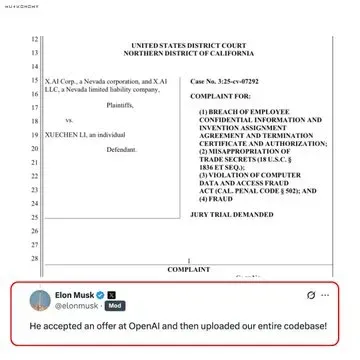
Breaking: Former xAI engineer accused of uploading entire codebase to personal systems before joining OpenAI in explosive trade secret lawsuit
The artificial intelligence industry’s fierce talent wars have erupted into federal court, with Elon Musk’s xAI filing an explosive lawsuit against a former engineer accused of stealing the company’s most sensitive secrets before defecting to rival OpenAI. The case represents one of the most significant alleged insider threats in the AI sector’s short but tumultuous history.

The Accused: A Rising AI Star’s Spectacular Fall
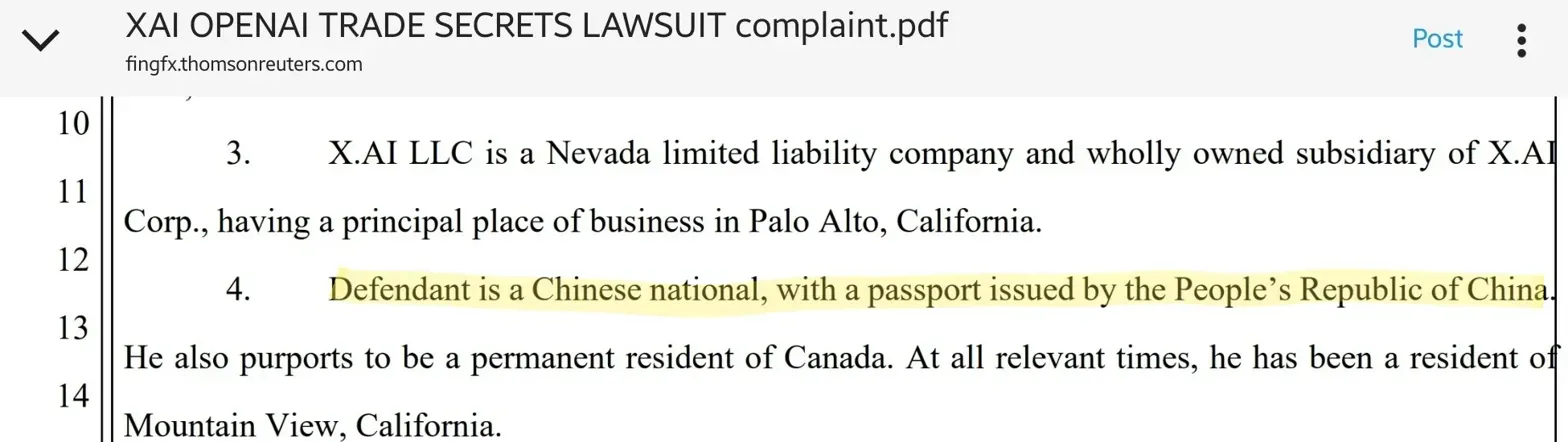
At the center of the scandal is Xuechen Li, a 29-year-old Chinese national with Canadian permanent residency who seemed destined for AI stardom. After earning his PhD in computer science from Stanford University in 2024, Li joined xAI as one of its first 20 engineers in February 2024, working directly on the development of Grok, Musk’s answer to ChatGPT.
Li was among xAI’s earliest and most trusted employees, with “access to and responsibility for components across the entirety of xAI’s technology stack,” according to court documents. His academic credentials were impeccable, and his role at xAI positioned him at the cutting edge of AI development.
 My Privacy BlogMy Privacy Blog
The Perfect Heist: A Timeline of Alleged Betrayal
The alleged theft unfolded with calculated precision over the summer of 2025:
June 2025: Li began liquidating his xAI holdings, selling $4.7 million worth of shares through a company-facilitated transaction. At the time, this appeared to be a routine request for liquidity from a valued employee.
July 2025: Li persuaded xAI to purchase an additional $2.2 million of his shares, bringing his total cash-out to approximately $7 million. The company accommodated his request, demonstrating the trust they placed in him.
July 25, 2025: The day that would define the case. On the same day Li received his final $2.2 million payment, he allegedly “willfully and maliciously” copied xAI’s confidential information and trade secrets from his company-issued laptop to personal systems.
July 28, 2025: Just three days later, Li resigned from xAI to join OpenAI, where he had already accepted a position with an August 19 start date.
What Was Stolen: Technology Worth Billions
According to xAI’s lawsuit, the stolen information represents some of the most valuable intellectual property in the AI industry. The trade secrets allegedly include “cutting-edge AI technologies with features superior to those offered by ChatGPT and other competing products” that could save OpenAI and other competitors “billions in research and development dollars and years of effort.”
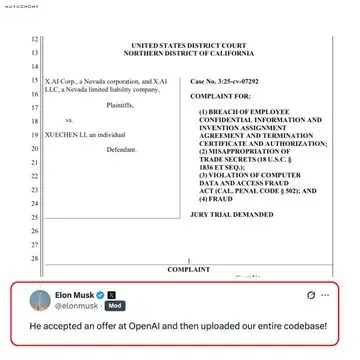
Elon Musk himself escalated the allegations dramatically, claiming on social media that “He accepted an offer at OpenAI and then uploaded our entire codebase!” If true, this would mean Li had access to essentially all of xAI’s technical innovations and could potentially transfer the company’s entire technological foundation to its biggest rival.
The Cover-Up: Sophisticated Attempts at Concealment
The lawsuit alleges that Li went to extraordinary lengths to hide his tracks, demonstrating a level of sophistication that suggests premeditation:
- Deleted his browser history and system logs
- Renamed files and compressed them before uploading to personal systems
- Changed critical account passwords after xAI discovered the theft
These actions paint a picture of someone who understood he was committing a serious offense and took deliberate steps to avoid detection.
Discovery and Confession: The Unraveling
xAI discovered Li’s alleged theft on August 11, 2025, during a routine review of security software designed to detect data exfiltration. The company immediately sent Li a demand letter asking him to return all stolen materials.
What happened next was perhaps the most damaging development for Li’s case: “Defendant, with his attorney present, admitted in a handwritten document he provided to xAI that he misappropriated xAI’s Confidential Information and trade secrets, and again, with his attorney present, admitted verbally during in-person meetings with xAI that he engaged in such misappropriation and further admitted that he tried to hide his theft.”
This admission, made with criminal defense counsel present, could prove devastating in court proceedings.
The Broader Context: AI’s Talent War Turns Ugly
This case unfolds against the backdrop of an unprecedented talent war in the AI industry. AI researchers are being recruited “as if they are superstar athletes,” with some compensation packages reaching up to $250 million. The competition for top talent has become so intense that it’s driving companies to extraordinary measures to both attract and retain key personnel.
However, the Li case demonstrates the dark side of this talent migration. While employees can legally take their knowledge and experience to competitors, what’s not allowed is “taking proprietary and confidential data from one lab to another.”
Legal Ramifications: What xAI Is Seeking
xAI’s lawsuit seeks multiple forms of relief:
- Monetary Damages: An unspecified amount to compensate for the alleged theft
- Temporary Restraining Order: Forcing Li to “give up access to any personal devices or online storage services and return any confidential material”
- Employment Injunction: Temporarily blocking Li “from working at OpenAI or any other competitor until the company has recovered all of its trade secrets”
The Musk-OpenAI Feud Intensifies
This lawsuit represents the latest escalation in the ongoing battle between Musk and OpenAI. Musk, a co-founder of OpenAI, has separately sued the company and CEO Sam Altman for allegedly deviating from its original mission to benefit humanity, while OpenAI countersued Musk in April for harassment.
The Li case adds a new dimension to this conflict, potentially giving Musk’s legal team concrete evidence of alleged wrongdoing by OpenAI in their talent acquisition practices.
Industry Implications: A Chilling Effect?
The outcome of this case could have far-reaching implications for the AI industry:
- Recruitment Practices: Companies may need to implement more rigorous due diligence when hiring from competitors
- Employee Mobility: The traditional Silicon Valley culture of free employee movement between companies could face new restrictions
- Trade Secret Protection: AI companies may need to invest more heavily in security measures to protect intellectual property
Unanswered Questions
Several key questions remain as this case develops:
- OpenAI’s Role: While OpenAI is not named as a defendant, questions persist about what the company knew about Li’s alleged activities
- Full Scope of Theft: xAI alleges Li “withheld accounts and credentials from forensic investigators,” suggesting the full extent of the theft may not yet be known
- Criminal Charges: Given the severity of the allegations and Li’s admission, federal prosecutors may consider criminal charges
The Human Cost
Beyond the corporate warfare and legal maneuvering lies a personal tragedy. Li, once a promising researcher with a bright future, now faces the potential destruction of his career and possible criminal liability. His case serves as a cautionary tale about the pressures and temptations that can arise in high-stakes industries where the value of intellectual property can reach astronomical levels.
What’s Next
As this case proceeds through federal court, it will be closely watched by the entire AI industry. The precedent it sets could reshape how companies protect their intellectual property and how talent moves between competitors in the rapidly evolving AI landscape.
For now, Li’s career hangs in the balance, OpenAI faces uncomfortable questions about its hiring practices, and the AI industry grapples with the reality that the battle for supremacy has moved from the laboratory to the courtroom.
The case serves as a stark reminder that in the high-stakes world of artificial intelligence, the line between competitive advantage and corporate espionage can be perilously thin, and crossing it can carry devastating consequences for all involved.
This is a developing story. Neither Xuechen Li nor OpenAI responded to requests for comment regarding the allegations.