Investigation underway as FBI-reported incident raises questions about timing and academic freedom
The peer-reviewed oncology journal Oncotarget has been taken offline by what its editorial team describes as a targeted cyberattack, occurring just days after publishing a comprehensive review examining reported cases of cancer following COVID-19 vaccination. The timing has sparked debate about potential censorship of scientific research, though the journal’s leadership has also pointed to ongoing disputes with scientific integrity watchdogs.
The Study at the Center of Controversy
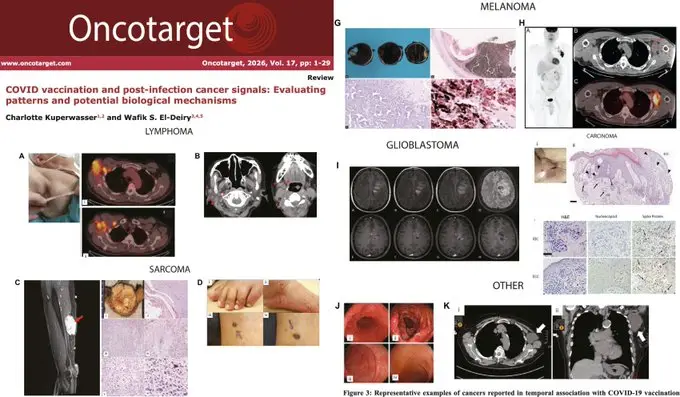
On January 3, 2026, Oncotarget published a systematic review titled “COVID vaccination and post-infection cancer signals: Evaluating patterns and potential biological mechanisms,” authored by prominent cancer researchers from Tufts University and Brown University. The study’s co-authors include Dr. Charlotte Kuperwasser from Tufts University School of Medicine and Dr. Wafik S. El-Deiry from Brown University’s Warren Alpert Medical School and Legorreta Cancer Center.
The review analyzed 69 publications from January 2020 through October 2025, documenting 333 patients across 27 countries who developed cancer or experienced rapid cancer progression temporally associated with COVID-19 vaccination or infection. The research included:
- 66 article-level case reports spanning multiple countries and cancer types
- 2 retrospective population-level studies from Italy (approximately 300,000 cohort) and South Korea (approximately 8.4 million cohort)
- 1 longitudinal analysis of roughly 1.3 million U.S. military service members
 Breached CompanyBreached Company
Key Findings
The review identified several recurring patterns in reported cases:
Cancer Types Documented:
- Hematologic malignancies including non-Hodgkin’s lymphomas, cutaneous lymphomas, and leukemias
- Solid tumors including breast, lung, melanoma, sarcoma, pancreatic cancer, and glioblastoma
- Virus-associated cancers such as Kaposi sarcoma and Merkel cell carcinoma
Notable Clinical Patterns:
- Unusually rapid progression, recurrence, or reactivation of pre-existing indolent or controlled disease
- Atypical or localized histopathologic findings, with some cases involving vaccine injection sites or regional lymph nodes
- Temporal association between vaccination/infection and cancer diagnosis or progression
Authors’ Cautious Interpretation
Despite documenting these patterns, the study’s authors emphasized the preliminary nature of the evidence and the need for rigorous follow-up research. They explicitly stated that “establishing causality between SARS-CoV-2 infection, COVID-19 vaccination, and cancer requires a level of evidence far beyond temporal association.”
The researchers characterized their findings as “hypothesis-generating rather than evidence of risk” and called for comprehensive studies integrating clinical, epidemiologic, and biological evidence. They noted significant knowledge gaps including limited long-term cancer surveillance, lack of molecular data, and incomplete understanding of individual susceptibility.
The paper concluded: “The collective world-wide evidence from 2020–2025 underscores a biologically plausible connection between COVID-19 vaccination and cancer,” while emphasizing this reflects plausibility for further investigation rather than established causation.
🚨 🚨🚨🚨 Shocking podcast with world renowned oncologist Dr. Wafik El-Deiry!
- Exposes COVID Spike protein’s cancer link!
- Urges autopsies to be done and slams pharma trolls discrediting his work
- Calls for FBI & Homeland Security to act.
Because I… pic.twitter.com/KblzQe9Um0
— aussie17 (@_aussie17) August 30, 2025
The Cyberattack
Within days of publication, Oncotarget’s website became inaccessible, displaying “bad gateway” errors. The journal’s homepage now carries a prominent notice stating:
“In December 2025 and January 2026, our server encountered malicious cyberattacks that led to disruptions of online publications and website access.”
The editorial team reported the incident to the FBI and indicated that attacks have continued. The journal has also made serious allegations suggesting potential involvement of individuals associated with PubPeer, a post-publication peer review platform, in “cybercriminal activities, including hacking servers, causing journal websites to go offline, and using illegitimate practices to influence Google search results for journals and scientists.”
Researchers Speak Out
Dr. Wafik El-Deiry expressed concern about the attack’s impact on scientific access, stating on social media: “Censorship is alive and well in the US, and it has come into medicine in a big, awful way.”
The timing of the attack—immediately following publication of a study examining potential vaccine safety signals—has led to speculation about targeted censorship. However, the journal notes this was not the first such incident, referencing a DDoS attack on December 23, 2022, that made their site inaccessible for several hours.
Context and Controversy
Journal Background
Oncotarget is an open-access, peer-reviewed journal that was accepted for MEDLINE indexing in September 2022 after previously being delisted. The journal is currently indexed by PubMed, MEDLINE, PubMed Central, Scopus, and EMBASE. It operates under a continuous publishing model and has published research from major academic institutions across the Ivy League and beyond.
The journal’s editorial board underwent significant expansion in July 2024, adding Dr. El-Deiry as Co-Editor-in-Chief along with numerous other prominent researchers in oncology and related fields.
Broader Scientific Debate
The published study adds to an ongoing scientific discussion about potential adverse events following COVID-19 vaccination. It’s important to note several contextual factors:
Acknowledged Limitations:
- The predominance of case reports rather than controlled studies
- Short follow-up periods in population-level data
- Potential for reporting bias and detection bias
- Lack of comparison to baseline cancer rates in unvaccinated populations
- The impossibility of establishing causation from temporal association alone
Existing Safety Data: The COVID-19 vaccines underwent extensive clinical trials involving tens of thousands of participants and have been administered to billions of people worldwide. Regulatory agencies including the FDA and EMA continue active safety monitoring through multiple surveillance systems designed to detect potential safety signals.
Study Design Considerations: As the authors themselves noted, COVID-19 vaccine package inserts state these products “have not been evaluated for carcinogenicity or genotoxicity, nor have they been studied after multiple vaccine doses and boosters or in combination with subsequent SARS-CoV-2 infection.”
I am pleased to share the peer-reviewed published manuscripts by
Kuperwasser and El-Deiry “COVID vaccination and post-infection cancer signals: Evaluating patterns and potential biological mechanisms”
and
El-Deiry “Hypothesis: HPV E6 and COVID spike proteins cooperate in… https://t.co/xtfc7uBcrx pic.twitter.com/MWNl95i30K
— Wafik S. El-Deiry, MD, PhD, FACP (@weldeiry) January 3, 2026
The Censorship Debate
The cyberattack has intensified debates about academic freedom and the ability of researchers to publish findings that may challenge prevailing views. Supporters argue that any impediment to accessing peer-reviewed research—regardless of its conclusions—threatens scientific progress and informed public health discussions.
Critics of the censorship narrative point out that:
- The study remains accessible through PubMed and other academic databases
- The cyberattack occurred amid ongoing disputes between the journal’s leadership and scientific integrity advocates
- Similar attacks targeting various journals and institutions have become increasingly common and may not be specifically motivated by study content
Healthcare Cybersecurity Context
This incident highlights the broader vulnerability of healthcare and academic institutions to cyberattacks. Recent years have seen numerous attacks targeting:
- Healthcare payment systems (such as the February 2024 Change Healthcare ransomware attack that disrupted oncology practices nationwide)
- Hospital networks and electronic medical records
- Research institutions and academic databases
- Pharmaceutical companies and biotech firms
The healthcare sector remains one of the most targeted industries for cyberattacks due to the value of health data, potential for ransomware payments, and critical nature of healthcare services.
Implications for Scientific Publishing
This incident raises important questions about:
Research Accessibility: How can scientific findings remain accessible when digital platforms face security threats?
Academic Freedom: Does the potential for cyberattacks create chilling effects on research into controversial topics?
Platform Security: What security measures should academic publishers implement to protect against targeted attacks?
Alternative Distribution: Should researchers maintain redundant publication channels to ensure findings remain accessible?
Moving Forward
The study’s authors have called for rigorous follow-up research including:
- Long-term epidemiologic studies with appropriate controls
- Clinical and histopathological investigations
- Mechanistic studies examining potential biological pathways
- Forensic analysis of reported cases
- Studies examining individual susceptibility factors
Regardless of the cyberattack’s motivation, the underlying scientific questions raised by the review merit serious investigation through well-designed studies that can provide definitive evidence regarding any potential associations between COVID-19 vaccination and cancer outcomes.
🚨BREAKING: Study Identifies Over 300 Peer-Reviewed COVID-19 “Vaccine” Cancer Cases Across 27 Countries — Journal Hit With Cyberattacks
Major cancer journal confirms global turbo cancer safety signal as CRIMINAL cyberattacks possibly linked to PubPeer disrupt access to the study… https://t.co/NolTLVT12I pic.twitter.com/PUvyYBGVGN
— Nicolas Hulscher, MPH (@NicHulscher) January 4, 2026
Current Status
As of January 12, 2026, Oncotarget’s website remains intermittently accessible, though the journal reports ongoing disruptions. The FBI investigation is reportedly ongoing, though no public statements about suspects or attributions have been released.
The published study remains available through academic databases including PubMed (PMID: 41498242) and continues to generate discussion in medical and scientific communities worldwide.
This article was compiled from publicly available information including the published research paper, journal statements, news reports, and academic databases. The views expressed by quoted individuals represent their own perspectives and not necessarily those of their affiliated institutions.
Note to Readers: This article presents a complex situation involving scientific research, cybersecurity, and ongoing debates about vaccine safety. Readers are encouraged to consult with healthcare providers about vaccination decisions and to review primary scientific literature when evaluating health information.