74 Warrants, a Luxury Bangkok Condo, and a DDoS Empire: The Arrest of Fluxstress Operator Noah Christopher
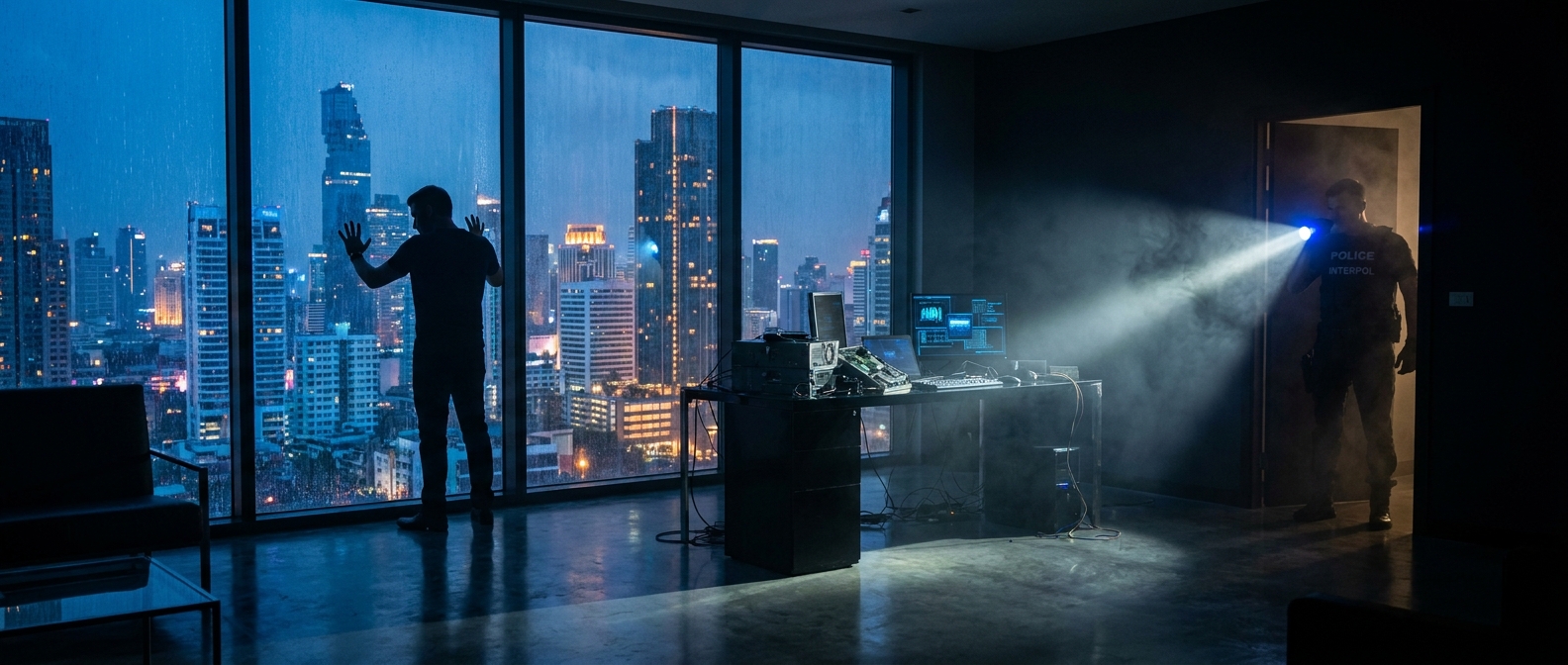
On April 11, 2026, officers from Thailand’s Cyber Crime Investigation Bureau and Immigration Bureau arrived at a luxury condominium on Soi Thonglor 25 in Bangkok’s Watthana district. Inside, they found Noah Christopher, a 27-year-old German national who had been living in one of the city’s most expensive neighborhoods for the better part of two years. He was wanted on 74 arrest warrants issued by German and European Union authorities, subject to an INTERPOL Red Notice, and allegedly responsible for building and running two of the more prolific DDoS-for-hire platforms of the past half decade.
Thai media, with characteristic efficiency, called him a “Bond villain.” The label is not entirely wrong. The man German prosecutors want back had allegedly built a turnkey cyberattack business, collected cryptocurrency from clients around the world, and been running from authorities since at least 2021 — through the UAE, through China, and finally to Bangkok, where he’d apparently concluded he could stay indefinitely.
He was wrong.
Who Is Noah Christopher
Details are still emerging, as is typical when international cybercrime arrest warrants unseal across multiple jurisdictions. What German and EU authorities have alleged, and what the INTERPOL Red Notice reflects, is that Noah Christopher developed, operated, and commercially ran at least two DDoS-as-a-Service platforms: Fluxstress and Netdowner (also referenced in some reports as Neldowner).
The platforms were active between approximately 2021 and 2025. During that window, Christopher allegedly marketed them to a global clientele — anyone willing to pay in cryptocurrency who wanted a website, server, or network infrastructure knocked offline. Prosecutors describe the operation as a Cybercrime-as-a-Service (CaaS) model: Christopher built and maintained the infrastructure, clients pointed it at targets of their choosing, and the attacks ran. No technical expertise required on the buyer’s end.
74 warrants is not a number that accumulates from a handful of incidents. It reflects years of sustained operation, hundreds of distinct criminal acts, and a law enforcement paper trail across multiple German states and EU jurisdictions that prosecutors spent years building. By warrant count alone, this is one of the larger DDoS-for-hire arrests in recent memory.
What Fluxstress and Netdowner Were
DDoS-for-hire platforms — also called “booter” or “stresser” services in the underground — have been a fixture of the cybercriminal economy since the early 2010s. The business model is straightforward: an operator acquires or rents botnet infrastructure (networks of compromised devices), builds a web panel or Telegram interface, and offers paying customers the ability to direct that firepower at targets.
Fluxstress and Netdowner fit this mold. Clients could log in, specify a target IP address or domain, select attack duration and volume, pay in cryptocurrency, and watch the target go dark. Pricing in this market ranges from a few dollars for short low-volume attacks — enough to disrupt a competitor’s gaming server or harass an individual — to thousands of dollars for sustained high-bandwidth assaults capable of knocking enterprise infrastructure offline.
The customers are not uniformly sophisticated. Booter services are used by:
- Gamers trying to disconnect opponents mid-match
- Competitors attempting to disrupt rival e-commerce sites during peak traffic periods
- Extortionists threatening sustained attacks unless victims pay
- Hacktivists targeting political or corporate entities
- Criminal operators using DDoS as a distraction during simultaneous data theft or fraud operations
The operator of a successful booter service doesn’t need to know or care why any given client wants a target offline. That’s the appeal of the CaaS model from a criminal perspective — and the danger of it from every other perspective. Christopher allegedly provided attack capability to anyone with cryptocurrency, at scale, for four years.
The Fugitive Trail: UAE, China, Bangkok
Noah Christopher’s trajectory before Bangkok illustrates a pattern that has become familiar in high-profile cybercrime cases: the flight toward jurisdictions with limited EU cooperation, combined with a lifestyle that doesn’t require physical presence in Germany.
After German authorities began building their case — eventually accumulating 74 warrants — Christopher reportedly moved first through the UAE, then through China, before settling in Bangkok. Both the UAE and China have historically provided friction for EU extradition requests, though neither is a safe harbor in the way popular imagination sometimes suggests. Thailand offered a different calculation: comfortable, accessible, relatively low law enforcement profile for a foreign national, and no obvious reason to expect German prosecutors would track him there.
He was apparently comfortable enough in Bangkok to stay for two years. He was reportedly traveling in and out of the country during that period — not hiding exactly, just living. The Thong Lor neighborhood where he was arrested is among Bangkok’s most expensive, popular with expatriates, and notably not the kind of place a person on the run typically keeps a low profile.
This pattern — cybercrime fugitives gravitating toward Bangkok, Bali, Phnom Penh, and similar destinations — is well-documented. The region has hosted a string of high-profile cybercrime cases over the past several years, from romance scam compounds in Cambodia and Myanmar to individual fugitives using Thailand’s visa flexibility and cost of living as an indefinite extension of their operational runway. The assumption, often reasonable historically, is that German arrest warrants and INTERPOL Red Notices lose momentum at a certain geographic distance.
That assumption is becoming less reliable. Thai-EU law enforcement coordination has expanded materially over the past two years. The CCIB, Thailand’s dedicated cyber crime investigation unit, has been more active in executing INTERPOL notices against foreign nationals than at any prior point in its history. Christopher’s arrest is the most recent example, but it is not an anomaly — it’s a trend.
The Arrest Operation
The April 11 operation was a joint action between Thailand’s Cyber Crime Investigation Bureau and the Immigration Bureau. Execution was clean: officers located Christopher at his Soi Thonglor 25 residence, arrested him under the INTERPOL Red Notice, and revoked his Thai visa. He is currently in custody in Thailand pending extradition proceedings to Germany.
Extradition from Thailand to Germany is procedurally possible — Thailand and Germany have an extradition treaty — but typically not fast. The process involves Thai court review of the extradition request, opportunity for the subject to contest extradition legally, and coordination between the two justice ministries. In practice, for a case with 74 warrants and an active INTERPOL notice, the legal challenge is more procedural speed bump than substantive barrier.
German prosecutors have been among the most aggressive in Europe in pursuing cybercrime cases internationally. The same prosecutorial machinery that assembled 74 warrants over four years is not likely to lose patience at the extradition stage.
Operation PowerOFF and the Broader DDoS Enforcement Campaign
Christopher’s arrest fits into a sustained international effort to dismantle DDoS-for-hire infrastructure. Operation PowerOFF — coordinated by Europol and Eurojust, with participation from the FBI, Dutch National Police, German BKA, and law enforcement agencies across more than a dozen countries — has been the primary framework for this work since 2018.
PowerOFF has resulted in the seizure of dozens of booter and stresser domains, the arrest of numerous operators, and a gradual attrition of the DDoS-for-hire marketplace’s most visible storefronts. The operation has specifically targeted the infrastructure layer — taking down platforms rather than just prosecuting individual users — which has proved more disruptive to the market than user-focused enforcement.
Christopher’s platforms, active from 2021 to 2025, appear to have operated throughout much of PowerOFF’s most active enforcement period. The four years it took to produce 74 warrants and ultimately locate him in Bangkok is a reminder that even under aggressive enforcement, disrupting a sufficiently distributed criminal operation takes time — and that time is where operators hope to exhaust prosecutorial patience.
They are finding that patience has gotten longer.
What This Means
74 warrants. Two years in Bangkok. A luxury condo in Thong Lor. An INTERPOL Red Notice that eventually reached Thailand’s Cyber Crime Investigation Bureau.
The Noah Christopher arrest is, in one sense, an operational success story for international law enforcement coordination — the machinery worked, eventually. In another sense, it’s a reminder of the structural features that make CaaS operations difficult to shut down: the operator is geographically mobile, the business is run remotely and pseudonymously, the customers are anonymous, and the jurisdictional complexity creates real delays even when the evidence is solid.
What has changed is the geographic perimeter of effective enforcement. Bangkok is no longer the end of the road. EU authorities are reaching further, coordinating better, and the INTERPOL Red Notice system is functioning as a meaningful international signal in jurisdictions where it previously generated limited operational response.
For the DDoS-for-hire operators still running platforms and looking at Thailand on a map as a strategic option: the calculus has changed.
Christopher is awaiting extradition to Germany. When he arrives, 74 charges will be waiting.