Eight days ago, FBI Director Kash Patel stood behind a podium and declared: “Iran thought they could hide behind fake websites and keyboard threats to terrorize Americans and silence dissidents.”
Today, those same hackers published his personal emails, photos, and documents online — and the Department of Justice confirmed it’s real.
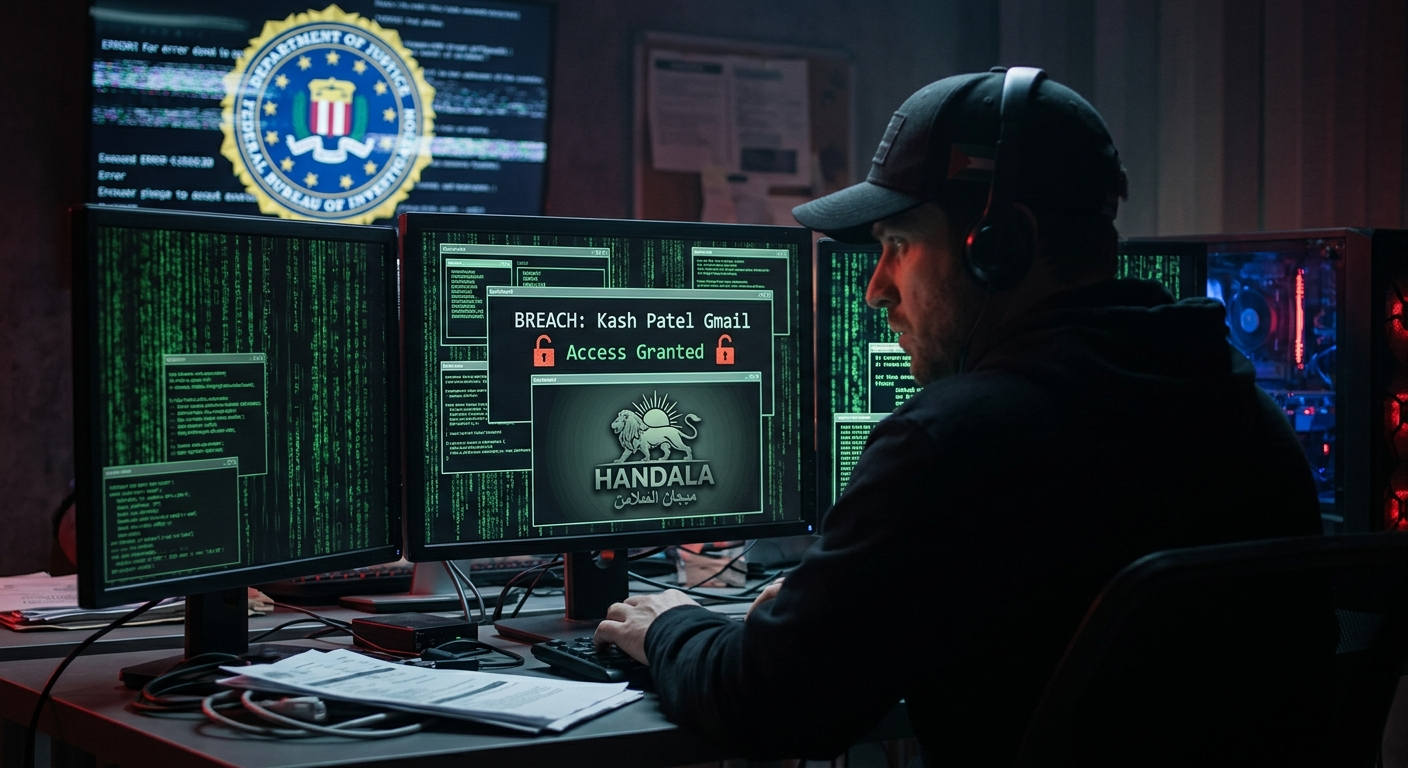
The breach of the FBI Director’s personal Gmail account by Iran’s Handala Hack Team is not just another data dump in the escalating US-Iran cyber conflict. It is a calculated humiliation of the man who runs America’s premier domestic intelligence agency, executed with surgical timing and unmistakable intent. And it exposes a persistent, systemic vulnerability that no amount of government cybersecurity investment can fix: senior officials conducting business on personal email.
What Was Taken
Handala published an 836.2 megabyte compressed archive containing the contents of Patel’s personal Gmail account. Reuters, which reviewed a sample of the material, confirmed it contains a mix of personal and work-related correspondence spanning from 2010 to 2019, though other reports suggest the archive extends through 2022.
The dump includes:
- Personal and business correspondence with various contacts over nearly a decade
- Travel-related communications and logistical arrangements
- Patel’s resume, complete with his personal email address and phone number
- Photographs — including images of Patel smoking cigars, posing in an antique convertible, and taking a selfie with a bottle of rum
A Department of Justice official confirmed to Reuters that Patel’s email had been breached and that the published material “appeared to be authentic.” The FBI itself offered no immediate comment — a conspicuous silence from the agency whose director just became the story.
The personal Gmail address Handala claims to have compromised matches one linked to Patel in previous data breaches preserved by dark web intelligence firm District 4 Labs. This detail is critical: it suggests Patel’s credentials may have been exposed in prior breaches, providing an initial attack vector.
Handala’s own statement was characteristically brazen: Patel “will now find his name among the list of successfully hacked victims.”
The Timing Was the Message
The chronology tells the real story.
February 28, 2026: The United States and Israel launch Operation Epic Fury against Iran. Missile strikes hit Iranian targets, including a school, killing at least 175 people. Iran’s internet connectivity plummets to 1-4%.
March 11, 2026: Handala claims a devastating wiper attack on Stryker Corporation, the $25 billion medical technology company with $450 million in Department of Defense contracts. Over 200,000 systems across 79 countries are reportedly wiped in a three-hour window.
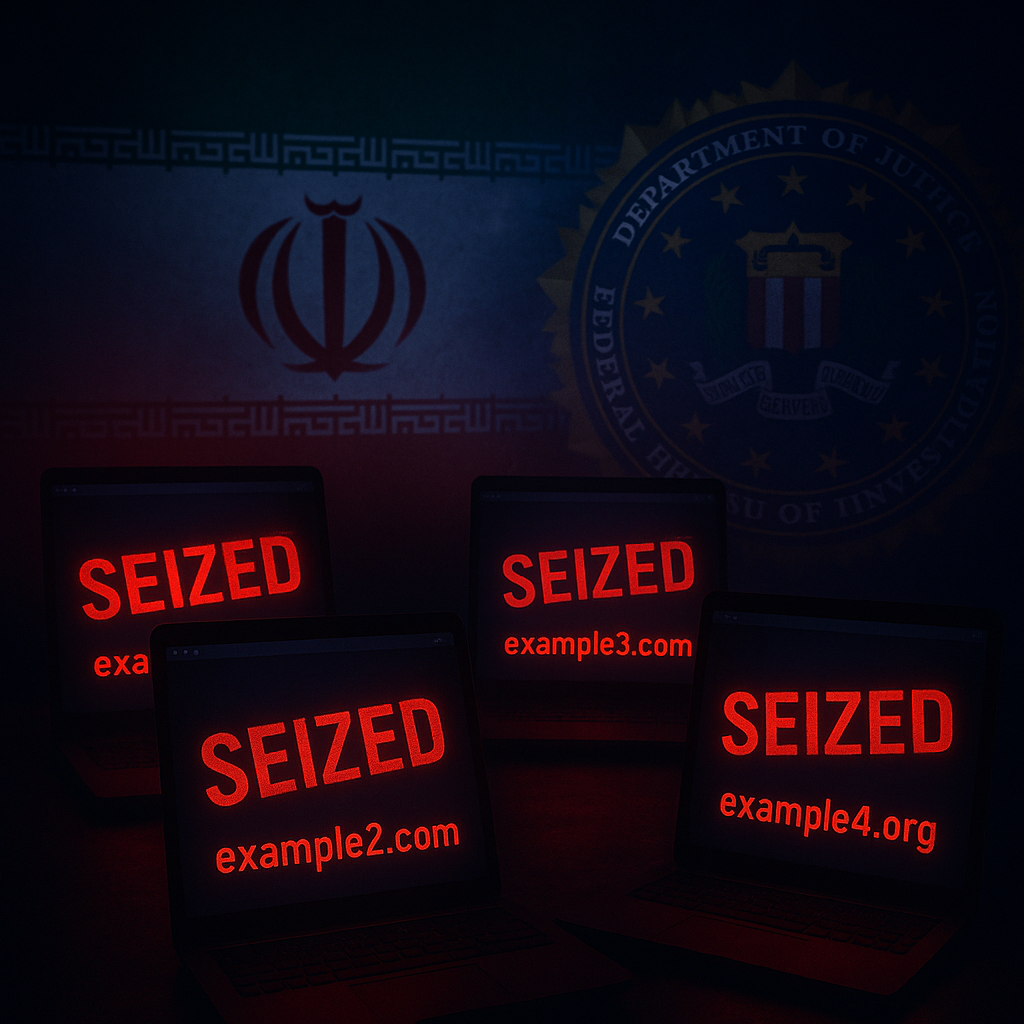
March 19, 2026: The DOJ announces the seizure of four Handala-linked domains — justicehomeland.org, handala-hack.to, karmabelow80.org, and handala-redwanted.to. Patel issues his public taunt. On that same day, Handala registers the domain that would be used to execute the attack on Patel’s Gmail.
March 23-24, 2026: Handala fully restores its online presence within 24 hours of the seizure, using Telegram channels, mirror sites, and backup domains.
March 27, 2026: The Gmail dump goes public.
The message is unmistakable: you took our domains, so we took your director’s inbox. As Handala wrote on Telegram: “We decided to respond to this ridiculous show in a way that will be remembered forever.”
Security researcher Reza Rafati of Cyberwarzone offered a prescient assessment after the domain seizures: “Domain seizures can interrupt a campaign. They rarely eliminate it.” The group treats infrastructure as “disposable” — their audience networks are the real asset.
Handala: Far More Than Hacktivists
Western intelligence services and cybersecurity researchers have long assessed that Handala Hack Team is not an independent hacktivist collective. It is an online persona operated by Void Manticore (also tracked as Red Sandstorm, Banished Kitten, Storm-0842, and Dune) — a unit affiliated with Iran’s Ministry of Intelligence and Security (MOIS).
The group first surfaced on December 18, 2023, launching both its Telegram channel and X/Twitter account simultaneously — a coordinated debut more consistent with state-sponsored information operations than grassroots hacktivism. It takes its name from Handala, the iconic Palestinian cartoon character created by political cartoonist Naji al-Ali, draping MOIS operations in the symbolism of Palestinian resistance.
Handala is part of a constellation of MOIS-linked personas that includes Karma (which Handala likely replaced) and Homeland Justice (responsible for attacks on the Albanian government since mid-2022). The operation was supervised by Seyed Yahya Hosseini Panjaki, MOIS Deputy Minister for Internal Security and Counter-Terrorism, who was sanctioned by the U.S. Treasury in September 2024 and subsequently by the EU and UK. Panjaki was reportedly killed during the opening phase of Israeli strikes on Iran in early March 2026 — meaning Handala may now be operating with reduced central command oversight.
That has not slowed them down. If anything, the operational tempo has increased.
The Stryker Precedent
The Patel breach cannot be understood in isolation. Two weeks earlier, Handala’s claimed attack on Stryker Corporation demonstrated the group’s evolving capabilities and willingness to strike at critical infrastructure.
In the Stryker operation, attackers compromised an internal administrator account and hijacked Microsoft Intune dashboards — the cloud-based device management service — to issue remote wipe commands to employee devices across 79 countries. Rather than deploying traditional ransomware or wipers through malware delivery, they weaponized the company’s own IT management tools against it. Over 200,000 systems were reportedly wiped in a three-hour window starting at 5:00 AM UTC. Twelve petabytes of data were claimed permanently destroyed, with 50 terabytes exfiltrated.
The healthcare impact was immediate. Surgical supply chains were disrupted. Maryland EMS suspended connections to Stryker’s LifeNet service, which transmits heart attack ECGs to emergency physicians, forcing paramedics to fall back on radio consultation. Five thousand workers were sent home from Stryker’s Ireland hub.
Handala labeled Stryker a “Zionist-rooted corporation,” referencing its 2019 acquisition of Israeli company OrthoSpace. But the targeting was strategic, not merely ideological — Stryker holds nearly half a billion dollars in DoD contracts.
The progression from Stryker to the FBI Director’s personal email reveals a group that operates across the full spectrum: destructive attacks on critical infrastructure, intelligence collection from senior officials, and psychological operations designed to embarrass and demoralize.
The Classified Question
Handala claims the dump contains classified files. This is unverified, and cybersecurity researchers who have reviewed portions of the archive urge caution.
Ron Fabela, a cybersecurity researcher who examined the material, described it as “much more mundane” than Handala’s grand claims: “This isn’t an FBI compromise — it’s someone’s personal junk drawer.” He characterized the contents as family photos and details about Patel’s previous apartment search.
But the “personal junk drawer” framing, while technically accurate, understates the risk. The archive spans years during which Patel held senior national security positions, including serving as a staffer on the House Intelligence Committee during its investigation of the Russia probe. Even “personal” correspondence from a figure with that access level can contain:
- Incidental classified spillage — the unintentional discussion of classified topics on unclassified systems, which is pervasive among senior officials
- Contact networks — who Patel communicated with, when, and about what, which is intelligence gold for a foreign service
- Personal vulnerability information — financial details, relationships, habits, and preferences that enable future targeting, blackmail, or social engineering
- Credential reuse patterns — login information that may overlap with government or other sensitive accounts
Even if the archive contains zero classified documents, the metadata alone — Patel’s contact graph over a decade of national security work — is a significant intelligence windfall for MOIS.
This Has Happened Before
This is not the first time Iran has compromised Patel’s communications. In late 2024, weeks before his appointment as FBI Director, Patel was informed that Iranian hackers had accessed some of his personal communications as part of a broader campaign targeting incoming Trump administration officials. That operation also targeted now-Deputy Attorney General Todd Blanche, former interim U.S. Attorney Lindsey Halligan, and Donald Trump Jr.
The fact that Patel was compromised twice by the same nation-state actor — using what appears to be the same personal email account — is a damning indictment of either his personal security practices, the government’s ability to protect its incoming officials, or both.
The Personal Email Problem
The Patel breach resurfaces an uncomfortable truth that the national security establishment has repeatedly failed to address: senior officials persistently use personal email for work-related communications, and there is no technical control that prevents it.
Government-issued devices and email systems (.gov, .mil) benefit from enterprise-grade security: hardware security keys for multi-factor authentication, continuous monitoring by SOC teams, endpoint detection and response tools, and DLP (data loss prevention) systems. Personal Gmail accounts — even with Google’s Advanced Protection Program enabled — exist outside this defensive perimeter entirely.
The problem is structural. Officials who rise to the level of FBI Director have decades of professional networking tied to personal email addresses. Contacts have those addresses. Correspondents use them by default. The personal inbox becomes an unmonitored shadow repository of sensitive communications, protected by nothing more than a password and whatever consumer-grade MFA the official has bothered to enable.
Google did not respond to requests for comment on whether Patel’s Gmail account had Advanced Protection enabled, or whether any suspicious access was flagged before the breach became public.
What Senior Officials Should Do (But Usually Don’t)
For any government official with access to sensitive information — and especially those in roles that make them high-value targets for nation-state actors — the following measures are the minimum:
-
Hardware security keys for all personal accounts. YubiKeys or Google Titan keys make credential phishing functionally impossible. Google’s Advanced Protection Program, which requires hardware keys, should be mandatory for any official who insists on maintaining a personal Gmail.
-
Assume the personal inbox is compromised. Operate under the assumption that any personal email account has been or will be breached. Never discuss work on personal channels, even obliquely.
-
Separate identities. Personal email addresses linked to prior data breaches (as Patel’s was, per District 4 Labs) should be considered burned. Create new accounts with no ties to the compromised identity.
-
Audit your breach exposure. Services like Have I Been Pwned and intelligence firms like District 4 Labs can reveal whether your credentials are already circulating. If they are — and for most people, they are — change everything immediately.
-
Monitor for social engineering. Once an attacker has your personal correspondence, they can craft highly convincing spear-phishing messages using your own words, contacts, and context. Treat any unusual communication with heightened suspicion.
The hard truth is that none of these measures would have been unusual or burdensome. They are basic personal security hygiene that the cybersecurity community has advocated for years. That the FBI Director’s personal email was apparently protected by less than what a security-conscious teenager would use is not a technology failure — it’s a culture failure.
Handala’s Technical Tradecraft
Research published by Check Point in March 2026 provides detailed insight into how Handala operates. Their initial access typically comes through brute-force attacks on VPN credentials — hundreds of logon attempts from commercial VPN nodes using default Windows hostnames (DESKTOP-XXXXXX / WIN-XXXXXX). They also target IT service providers for supply chain access.
Once inside a network, Handala establishes extended dwell times — months in some cases — before initiating destructive operations. They move laterally via extensive RDP usage and deploy NetBird, an open-source mesh networking tool, to maintain persistent access. Check Point observed at least five attacker-controlled machines operating simultaneously within single victim environments.
Their destructive toolkit includes a custom Handala Wiper deployed via Group Policy logon scripts, a PowerShell-based wiper (which Check Point assessed as AI-assisted based on code structure and comments) that fills storage volumes with copies of a file named Handala_$i.gif until exhaustion, and VeraCrypt disk encryption to complicate forensic recovery.
One notable detail from Check Point’s research: after the January 2026 Iranian internet disruptions, Handala operators began connecting from Starlink IP ranges and directly from Iranian IP addresses — indicating declining operational security as Iranian infrastructure degraded. This OPSEC erosion may ultimately prove more valuable to Western intelligence services than any domain seizure.
What Comes Next
The Patel breach will generate headlines for its embarrassment factor — the cigars, the convertible, the rum selfie. But the serious implications run deeper.
First, Handala has demonstrated that it can and will directly target the most senior U.S. law enforcement and intelligence officials. The FBI Director’s personal email today; whose tomorrow? The NSA Director? The CIA Director? Every senior official’s personal digital footprint is now a potential attack surface in an active cyber conflict.
Second, the breach occurred during an ongoing military confrontation between the United States and Iran. The intelligence value of an FBI Director’s personal communications — even “mundane” ones — is non-trivial for an adversary actively engaged in military and cyber operations against the United States.
Third, the $10 million Rewards for Justice bounty on Handala members has not deterred them. Domain seizures have not stopped them. If anything, enforcement actions have accelerated their operations and sharpened their targeting. The group’s supervisor may be dead, and they are still operating at full capacity. The traditional deterrence model is not working.
Finally, and most fundamentally: this breach was preventable. A hardware security key on a personal Gmail account would likely have stopped it. The fact that the Director of the Federal Bureau of Investigation — the agency responsible for investigating cybercrime in the United States — did not take this basic precaution is a failure that will resonate far beyond this news cycle.
The hackers’ own words may be the most apt summary. On Telegram, Handala declared: “The so-called ‘impenetrable’ systems of the FBI were brought to their knees within hours by our team.”
That’s hyperbole. They didn’t breach the FBI. They breached a Gmail account.
But that’s precisely the point.
This is a developing story. We will update this article as new information becomes available.